Wednesday, November 30, 2011

So Little Time, So Much To Know!


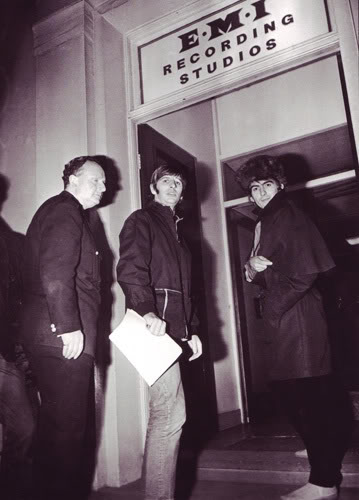
By June 26th, 1968, all four Beatles were together again in EMI Studios recording their new album. The first two weeks of sessions concentrated on "Everybody's Got Something To Hide Except Me And My Monkey", "Good Night", and "Ob-La-Di, Ob-La-Da".

Spare days saw them assisting other Apple artists, as Paul produced "Those Were The Days" for Mary Hopkin and George (with help from Paul and Ringo) worked on "Sour Milk Sea" with Jackie Lomax. On June 30th, Paul recorded the Black Dyke Mills Band performing "Thingumybob" and "Yellow Submarine".

A press preview of the animated film Yellow Submarine was held July 8th at the Bowater House Cinema in London. For some reason, John and Yoko failed to show up, but the other three were there to chat with reporters from ITV News and other outlets. All four Beatles did attend the movie's public premiere on July 17th at the London Pavilion, an event captured on camera for BBC1's How It Is.

Tuesday, November 29, 2011

Apple Plugging


As soon as they had begun, the "White Album" sessions were put on hold when George and Ringo flew to California on June 7th, 1968. During a visit to Big Sur on June 10th and 11th, George participated in filming for the documentary Raga, featuring Ravi Shankar:


Until George and Ringo's return on June 18th, John and Paul worked largely on individual efforts. They held sessions at Abbey Road to work on sound effects for "Revolution 9" and the play In His Own Write (John), and to record "Blackbird" (Paul). Rehearsals of the latter, from a June 11th session, were captured in a short promotional film, Apple, directed by Tony Bramwell:


Meanwhile, John and Yoko planted acorns for peace as their contribution to the National Sculpture Exhibit, attended the opening of In His Own Write, and produced a pair of short films, Two Virgins and Film No. 5 (Smile):


On June 16th, Paul taped a TV appearance with Frankie Howerd, introducing Apple's latest signing, Mary Hopkin. Then it was his turn to fly to California and promote Apple on the West Coast, staying from June 20th through the 25th and talking with Bobby Dale about the fledgling company.

Monday, November 28, 2011

Rousing Crescendo


The "White Album" sessions got underway May 30th, 1968 at EMI Studio Two. The first three dates were spent recording a version of "Revolution" which would end up split in two parts as "Revolution 1" and "Revolution 9".

On June 5th, the Beatles started work on Ringo's first composition, "Don't Pass Me By". The next day, as the others worked on overdubs in Studio Two, John sat with Victor Spinetti in Studio Three for a filmed TV interview. John's books had been adapted by Spinetti and Adrienne Kennedy into a stage play, In His Own Write, which would be opening soon at the Old Vic. Peter Lewis talked with John and Victor about the production for BBC2's Release, broadcast June 22nd.

With that done, John sat down "cross-legged on his amplifier", strumming a fretless guitar, and bantered amusingly with BBC Radio's Kenny Everett. When they had finished overdubbing, the other Beatles joined the fun, playing and singing impromptu jingles for Kenny. An abbreviated version of this recording, overlaid with sound effects, was heard on The Kenny Everett Show June 9th. A longer edit was released on a promotional Apple single, Una Sensazionale Intervista con I Beatles. Here is the unedited tape of the interview, complete with narration by Kenny's tape recorder-owning chum Tony Olivestone.

Tuesday, November 22, 2011

Miasmic Climaxes


The two weeks between John and Paul's return from America on May 16th, 1968 and the start of the "White Album" sessions on May 30th were a busy time for the Beatles.

A few days after returning to Kenwood, with his wife away in Greece, John invited Yoko Ono over; they broke the ice by recording Unfinished Music No. 1: Two Virgins. George and Ringo were at the Cannes Film Festival attending the premiere of Wonderwall. They returned on the 19th, just in time to attend a housewarming party thrown by playwright Harold Pinter.

On the 21st, Paul and Jane Asher attended an Andy Williams concert at the Royal Albert Hall; on the 22nd, John and George attended a luncheon to launch Apple Tailoring, the company's second London boutique. On the 23rd, Paul and Ringo were filmed at EMI Studios for Tony Palmer's TV documentary about the British rock scene, All My Loving. It was aired on BBC's Omnibus series November 3rd.

May 26th found Paul at Kensington Gardens directing a promotional film clip for Apple Publishing artists Grapefruit's new single, "Elevator". Somehow, during all this activity, the group found time to record close to 30 demos of songs for their next album, mostly composed in Rishikesh.

Finally, here are a couple of promos for Toronto radio station CHUM-FM, recorded by Paul on an unknown date circa 1968.

Monday, November 21, 2011

Where's Johnny?


The Lennon-McCartney publicity blitz promoting Apple Corps in New York City reached its zenith on May 14th, 1968. The day began with a 1:30 pm press conference at the Americana Hotel.

John and Paul then taped an interview for the local public TV station, WNDT, chatting with Mitchell Krause for Newsfront. The awkward and mostly unrevealing discussion was broadcast the following night, but only survives as an off-air audio recording.

Likewise the duo's appearance that evening on NBC's The Tonight Show, the master tape of which was erased along with most of Johnny Carson's first ten years as host. Carson wasn't even in town that night, so baseball announcer Joe Garagiola did his best to fill in as guest host; actress Tallulah Bankhead livened up the proceedings somewhat.

Friday, November 18, 2011

An Expanding Vista


With India seemingly in their rear-view mirrors, it was time for the Beatles to concentrate on their new business venture, Apple Corps. Apple Tailoring and Publishing were already established, and the record label would soon follow, along with Apple Films, Electronics, and a whole host of ideas that never made it off the ground. Now it was time to emblazon the company's name into America's consciousness.

Accompanied by Derek Taylor, Mal Evans, and Neil Aspinall, John and Paul flew to New York City on May 11th, 1968 for a press blitz unparalleled since their touring days. Many of the interviews were conducted out of the St. Regis Hotel on May 13th, most notably a filmed chat with their erstwhile touring companion, Larry Kane.

Thursday, November 17, 2011

Limitless Undying Love


Before heading off to India, the Beatles spent a few days in early February, 1968 at EMI Abbey Road recording tracks for a stopgap single to be released during their absence. In the midst of the sessions, Ringo appeared live on Cilla Black's new TV series. "Lady Madonna" and "The Inner Light" ended up on the single, while John's "Across The Universe" was donated to a (much-delayed) charity LP, and his "Hey Bulldog" was slated for Yellow Submarine:


John and George flew to Rishikesh on February 15th, and Paul and Ringo followed three days later. ITV News interviewed Maharishi Mahesh Yogi at the outset of the group's pilgrimage to his his ashram.

Ringo and Maureen lasted only ten days, while Paul and Jane returned home on March 26th. At London Airport, Paul explained to the BBC's Richard Whitmore and another interviewer what life was like at the retreat, and their reasons for returning to England. By April 12th, John and George had also gotten their fill of the Maharishi; John beat a hasty retreat to London, while George stayed in India, visiting Madras.


Wednesday, November 16, 2011

Newer And Bluer Meanies


With Apple in its embryonic stages and no group projects in the pipeline, 1968 began on a quiet note for the Beatles.

On January 7th, George flew to India to record at EMI's Bombay studios. Most of the material was for the Wonderwall film score, but he also produced the basic tracks for "The Inner Light" there on January 12th.

Apple's first headquarters officially opened at 95 Wigmore Street on January 22nd; three days earlier, the Beatles had attended a launch party there for Apple Publishing's first signing, Grapefruit.

Later that week, they gathered at Twickenham Studios to film their closing cameo appearance in Yellow Submarine:


On January 27th, Kenny Everett visited Kenwood to record an interview with John for his BBC Radio 1 series, The Kenny Everett Show (broadcast February 4th).

Tuesday, November 15, 2011

Frosty Reception


1967 ended on a disappointing note for the Beatles. Magical Mystery Tour was released as an LP (by Capitol in North America) on November 27th, and as a double EP (by Parlophone in the UK) on December 8th.

Along with the single "Hello Goodbye", the new music was well-enough received, but the TV film would have a different fate. It was previewed for the Beatles Fan Club Area Secretaries on December 17th (attended by John and George, as Ringo was returning from filming Candy in Rome and Paul was away in Scotland).

All four Beatles threw a fancy dress party on the 21st to officially launch the film, but the initial broadcast on BBC-1 (in black and white) on Boxing Day was a critical disaster. So negative were the reviews that Paul agreed to appear on Rediffusion-TV's The Frost Programme the very next evening, where he defended the project to David Frost as a noble failure.

Monday, November 14, 2011

Plenty Of Jam Jars


I seem to have already posted most of 1967's remaining interviews and spoken word bits, so here's a quick recap:

John and George pontificated about Transcendental Meditation on The Frost Programme September 29th and then again on October 4th.

In mid-November, John appeared on BBC Radio's Where It's At, chatting with Kenny Everett and Chris Denning about Magical Mystery Tour.

On November 28th, the Beatles recorded their fifth (and in my opinion, funniest) Fan Club Christmas Message:


Early in December, George spoke about Ravi Shankar and Indian music in general on the PBS series Public Broadcasting Laboratory.

Thursday, November 10, 2011

It's A Mystery To Me


In the immediate aftermath of Brian Epstein's death, the Beatles' future was in question. The seeds for Apple Corps had already been planted, and Brian's brother Clive would succeed him as the head of NEMS Enterprises. Beyond that, Paul took the reins in leading the group into the studio and then on location for the Magical Mystery Tour project.

They spent the week of September 5th-8th, 1967 working on songs for the film at EMI, then piled into the big yellow motorcoach on the 11th to begin filming. The next afternoon, as the cast and crew stopped for lunch at Plymouth's Grand Hotel, BBC reporter Hugh Scully tried in vain to get Paul to describe the project for viewers of Spotlight South West.

On the 13th, George sat down with Miranda Ward and went into much greater detail about the reasons for the film, as well as his latest spiritual developments, for Scene And Heard. Ward chatted with Ringo the next day about far less weighty matters.

The second week of shooting was centered around a single location, West Malling Air Station in Kent. When it was done, the group returned to EMI for further recording dates.


September 25th found them recording "The Fool On The Hill", with reporter Rumiko Hoshika and photographer Koh Hasebe visiting from Japan. The lengthy tape of Rumiko's interviews, as well as "Fool On The Hill" rehearsals, only circulates in atrocious sound quality. Far easier on the ears are these messages to Rumiko, recorded sometime after her earlier visit to London (she had attended the session for "It's Only Love" on June 15th, 1965).

Wednesday, November 9, 2011

You Just Keep Going, Really


Pattie Harrison had begun studying Transcendental Meditation in 1967, so it was natural that she would encourage her husband to attend a lecture on the topic at the London Hilton by Maharishi Mahesh Yogi. George rounded up John and Paul for the August 24th event (Ringo was busy attending to his wife and newborn son, Jason).

After meeting the guru backstage, the Beatles readily agreed to drop everything and participate in the Maharishi's week-long TM conference in Wales. The next day, the Maharishi spoke to a reporter at Euston Station in London before he and all four Beatles boarded a train bound for Bangor.

They barely had time to settle into a routine at Normal College before harsh reality intruded: on the morning of August 27th, Brian Epstein was found dead in his bedroom of an apparent drug overdose. Paul and Jane Asher took the next available train back to London, while his bandmates spoke to reporters from ITV and BBC News about their feelings.

Tuesday, November 8, 2011

Action/Reaction


The Summer of Love rolled along as July 1967 turned to August. Just two days after returning from Greece, George and Pattie Harrison (accompanied by Neil Aspinall) flew to Los Angeles on August 1st, where they would spend a week visiting Derek Taylor. Taylor's tardiness that first evening inspired the composition "Blue Jay Way".

Most of the week was dedicated to Ravi Shankar, as George visited his music academy on the 2nd, held a joint press conference with Ravi on the 3rd, attended Shankar's Hollywood Bowl concert on the 4th, and stopped by tabla player Alla Rakha's recording session on the 5th.

On August 8th, the Britishers made an enlightening (in a disappointing sense) visit to San Francisco's Haight-Ashbury district. Later that night, George, Pattie, and Neil flew to New York for a one-day stay before returning to London. Shortly before their flight home on the 9th, George stopped by WOR-FM's studio to grant an interview with Murray "the K" Kaufman, who seemed to have eagerly adopted and embraced the hippie way of life.

Monday, November 7, 2011

Be At Leso


At the urging of their new electronics guru "Magic" Alex Mardis, the Beatles decided to take a holiday in Greece during the last week of July, 1967. Soaking up the warm Mediterranean sun and tripping the days away, they hatched elaborate plans to purchase an island, build a recording studio and homes for the entire Beatles clan, and pack up and leave chilly England for good.


Back in the sobering light of British day, once the legalities had been examined, the idea was abandoned. Ringo returned to London first, on the 26th, and five days later, he represented his bandmates in recording a farewell message to Radio London. The Marine Offences Act would be passed on August 14th, effectively shutting down all pirate radio stations off the UK's coast. Ringo's message was played on August 5th, Radio London's final broadcast day at sea.

Friday, November 4, 2011

Two Of The Beautiful People


Even as late as the summer of 1967, it was possible to meet a Beatle by simply marching up to the front gate of their home and ringing the bell (or waiting for them to arrive or exit). Two American students, Leslie Samuels and Donna Stark, accomplished the feat on July 12th, bringing their cameras and a tape recorder to document the occasion.

Crude but lengthy recordings of their meetings at 7 Cavendish Avenue and Kinfauns circulate; more details and photos of the pilgrimage can be found on Sara's Meet The Beatles For Real blog.

Thursday, November 3, 2011

Acid Test


Sgt. Pepper's Lonely Hearts Club Band was launched with a press event at Brian Epstein's London flat on May 19th, 1967. A day later, Kenny Everett broadcast most of the LP for the first time on BBC Radio's Where It's At, accompanied by exclusive interviews with John, Paul, and Ringo.

The album was released June 1st to near-universal acclaim, kick-starting the Summer of Love. But before the calendar had officially turned to summer, Paul McCartney found himself in hot water for comments about LSD. In the June 16th issue of Life magazine, he was quoted as saying, "After I took it, it opened up my eyes... If the politicians would take LSD, there wouldn't be any more war, or poverty or famine."

Of course, many pop stars had been experimenting with LSD for the better part of two years, including Paul's bandmates, but this first public admission came as a surprise to most of the British public. Paul spoke at home with an ITV News interviewer on June 19th, and turned the questions around, wondering why media outlets would disseminate this "news" if they were worried about it corrupting the youth of the world.

All was forgiven and forgotten a week later when the Beatles represented their homeland on the global telecast Our World, singing "All You Need Is Love".

Wednesday, November 2, 2011

I.T.'s All Too Much


The Sgt. Pepper recording sessions wrapped up April 3rd, 1967, with the final overdubs on George's contribution, "Within You Without You". The same day, Paul flew to the US, accompanied by Mal Evans, to surprise Jane Asher in Denver on her 21st birthday. On his April 11th return flight to London, Paul sketched out a rough idea for a Beatles TV film. By the 25th, the band was back at EMI recording the film's title song, "Magical Mystery Tour".

On the evening of April 29th, John Lennon dropped acid and dropped in on the 14-Hour Technicolor Dream, a "happening" taking place at the Alexandra Palace in London. One of the events being presented was Yoko Ono's "Cut Piece", although it's not known if John was aware of the connection (or even there to witness it):


A couple of weeks later, George Harrison sat down for a very lengthy interview with Barry Miles, co-founder of London's underground paper, the International Times. The contents of the rambling conversation are far removed from jelly babies, haircuts, and the usual Beatles interview fodder. In addition to discussing the Technicolor Dream, George and Barry ponder universal love, drugs, Zen Buddhism, mantras, reincarnation, and other weighty topics.


Tuesday, November 1, 2011

A Completely Different Scene


As winter turned to spring in 1967, the Sgt. Pepper sessions were drawing to a close. After four months with nary a peep from the Beatles (apart from a groundbreaking single), it was BBC Radio's Brian Matthew who returned with news from the front following his visit to EMI Studio 2 on March 20th.

His first task was to record John and Paul accepting three Ivor Novello awards, and discussing the winning songs, all Lennon-McCartney compositions. The recording would be played back during the ceremony on March 23rd and subsequently aired on BBC Radio March 27th.

Brian then chatted with John and Paul about the upcoming LP, and the future of the Beatles' concert career, for Top Of The Pops, sent to BBC Radio's overseas customers for broadcast in America and other markets.

Friday, October 28, 2011

As Bad As The Monkees


Being ensconced in EMI Studios throughout the first three months of 1967, the Beatles made few public appearances and gave few media interviews, apart from Paul's appearance in a Granada TV documentary.

An early clue to the new direction surfaced February 13th (in the US; February 17th in the UK) with the release of the single "Strawberry Fields Forever"/"Penny Lane". The recordings, together with the picture sleeve photo and psychedelic promotional films, represented a radical new sound and look for the Beatles.

Kenny Everett played an advance copy of the single on Radio London on February 4th, and fell instantly in love with "Strawberry Fields Forever". US teenagers were less convinced when viewing the promo clips on American Bandstand March 11th.

Capitol's promotional copies of the single sent to disc jockeys in the US and Canada used an early mix of "Penny Lane", highlighted by a seven-note piccolo trumpet coda. This version was commonly heard on the radio well after the single's release, as this March 26th aircheck on WFOM in Marietta, Georgia proves. During a trip to New York City in March, Brian Epstein explained to Murray the "K" that it was Paul's perfectionism which caused the last-minute switch.

Thursday, October 27, 2011

The End Of Beatlemania?


The "studio years" phase of the Beatles' career began when they reassembled at EMI Abbey Road on November 24th, 1966. With no tour or film commitments booked, they were able to record at their leisure, utilising seven sessions over the next five weeks to perfect a single song, John's "Strawberry Fields Forever".

On November 25th at Dick James's London studio, they recorded their annual Christmas message for Beatles Fan Club members, this one more creative (and bizarre) than any previous:


Two pirate radio stations were also sent slightly saner Christmas greetings for 1966.

By December 20th, ITV News decided to send reporter John Edwards to Abbey Road to see just what the Beatles were up to. His interviews with each Beatle as they entered the studio were broadcast December 29th as part of Reporting '66: End of Beatlemania, a title which indicates his line of questioning to the now fuzzy-faced Fabs.

Wednesday, October 26, 2011

Misunderstanding All You See


Road-weary and shell-shocked after a harrowing summer of worldwide touring and controversy, the Beatles retreated to individual pursuits from September through November, 1966.

John Lennon flew to West Germany on September 5th, had his moptop cropped, and began filming How I Won The War under Richard Lester's familiar direction. John returned to London September 14th, the same day George and Pattie Harrison left for Bombay. They would spend the next five weeks in India, where George would receive sitar tutelage from Ravi Shankar.

On September 18th, John flew to Almeria, Spain, for a more extended location shoot for How I Won The War. While there, he composed "Strawberry Fields Forever", welcomed a visit from Ringo and Maureen Starkey, and gave a lengthy interview to Fred Robbins.

Paul McCartney busied himself composing music for the film The Family Way, arranging and recording the score with George Martin's assistance. He then took a sightseeing trip with Mal Evans to France and Spain, arriving a few days too late to meet up with John, whose part had wrapped on November 6th. Paul and Mal then spent a week on safari in Kenya, finally returning to London November 19th.

All of these separate activities caused rampant speculation in the press that the Beatles were on the verge of breaking up. Brian Epstein denied these rumors at every occasion - to Dieter Broer in September, during a German press conference for John's film, and again to Reuters on November 8th. But privately, Brian was terrified that the Beatles no longer needed him; after overdosing on pills, he checked himself into a clinic on September 27th to recuperate.

Meanwhile, John Lennon's life was about to take a sharp left turn, after his meeting with avant-garde artist Yoko Ono at the Indica Gallery on November 9th. His performance as a doorman on the Dudley Moore/Peter Cook TV sketch show Not Only... But Also, filmed November 27th, was the last public appearance of "Beatle John".

Tuesday, October 25, 2011

I'm Not A Beatle Anymore


The Beatles' concert career came shrieking to a halt in San Francisco just before 10pm on August 29th, 1966, as the group roared through "Long Tall Sally" one final time.

KYA radio plugged the performance, with no hint that it was anything other than "the last show of their biggest American tour". Nor did fans at Candlestick Park sense anything historic about the occasion. John, George, and Ringo gave no clues when speaking to WTRY's Lee Darling backstage.

But when they boarded a flight back to London on August 30th, George Harrison declared to nobody in particular, "Well, that's it. I'm no longer a Beatle". When they landed on the 31st, their only declaration was that it was time to rest, but the Beatles would never set off on tour again.

Monday, October 24, 2011

Ho Ho Ho


The Beatles flew to Seattle on August 25th, 1966, for two concerts at the Seattle Coliseum. Vancouver's CFUN radio kept fans abreast of the ticket sales and a rumor that Paul would be marrying Jane Asher that very day. A local TV reporter grabbed a few words from Ringo as he deplaned at Sea-Tac Airport.

Between concerts, Dusty Adams interviewed all four Fabs backstage, and a press conference (most likely the final ever held by the group on tour) occurred just prior to the second show. Rather than staying in Seattle, The Beatles flew back to Los Angeles immediately after the last concert.

Friday, October 21, 2011

When The Bubble Bursts


Kenny Everett switched on his tape recorder as the Beatles' flight from New York approached the Los Angeles airport in the pre-dawn hours of August 24th, 1966.

Rather than play in Los Angeles right away, the city (a rented private home in Beverly Hills) was used as a base for the final week of West Coast concerts. Their only task on the evening of the 24th was a press conference at the Capitol Records Tower, with more humorous moments than any previous 1966 conference. At the end, a reporter representing Dick Clark's ABC-TV show Where The Action Is tried to film exclusive interviews with George and Paul, but as you can hear, the result was unusable.

Thursday, October 20, 2011

Nothing To Shea But It's OK


The Beatles' final concert in New York would be at Shea Stadium, but compared to the previous year's record-setting sellout, the 1966 performance was only about 80% full.

The group arrived at LaGuardia Airport on August 22nd, flying direct from St. Louis and landing around 3:50 in the morning. As they slept into the afternoon at the Warwick Hotel, an Associated Press reporter interviewed a devoted fan outside.

The Beatles eventually emerged for an early evening press conference, followed by a special "junior" press conference, with contest-winning fans asking the questions, which were both more interesting and more inane than those posed by the "real" journalists. They also spoke with "Cousin" Bruce Morrow live on WABC radio following the two conferences. That night, Brian Epstein appeared on NBC's Tonight Show, with guest host Hugh Downs filling in for Johnny Carson.

On the 23rd, George chatted with Kenny Everett prior to the concert at Shea. Covering the concert were a somewhat cynical Leonard Harris from WCBS-TV and an enterprising reporter for the Audio Journal company, who released an audio-verite souvenir LP called Beatles at Shea Stadium Described by Erupting Fans.

Wednesday, October 19, 2011

Doubleheader


Heavy downpours and a lack of protection over the stage cancelled The Beatles' scheduled concert in Cincinnati on August 20th, 1966, forcing them to "play" a doubleheader in two cities the following day.

They began in the afternoon with the rain check show at Crosley Field in Cincinnati, then flew to St. Louis for another rainy show (this time under a canopy) at Busch Stadium. Bess Coleman kept the fans up to date with on-the-spot reports from both Cincinnati and St. Louis.

St. Louis was disc jockey Ken Douglas's final stop on the tour; here are some of his undated Beatle interviews and a quick chat with Brian Epstein. The Beatles' next stop would be New York City, where WMCA-AM had been cranking up the hype machine as usual all week long.

Tuesday, October 18, 2011

Doped With Religion


From the time John Lennon's "more popular than Jesus" remarks made headlines, the backlash was largely concentrated in America's southern "bible belt".

England's ITV News sent reporter Richard Lindley to the US to assemble a package for the news program Reporting '66. He began in Birmingham, Alabama, interviewing local teenagers as well as disc jockey Tommy Charles. On August 19th, Lindley was present in Memphis to cover the Beatles' concerts at Mid-South Coliseum, where a cherry bomb tossed during the second house was the only real disruption.

Eventually, Tommy Charles decided WAQY had milked all the publicity it could from the tempest and decided to accept John's apology.

Monday, October 17, 2011

Cornflakes, Mini Minor, Blue, Blonde...


The Beatles' August 18th, 1966 concert at Suffolk Downs in Boston was highlighted by a fan jumping onstage during "Long Tall Sally", a moment captured by Kenny Everett.

Elsewhere, Jim Stagg got a few words from George as he deplaned at Logan Airport, and talked with Paul and George at the Somerset Hotel. Bess Coleman had lengthy chats with each Beatle at the hotel, and filed another brief tour report describing the previous day's Toronto concerts.

Friday, October 14, 2011

We're Not Allowed To Have Opinions


The Beatles' final performances in Canada were at Toronto's Maple Leaf Gardens on August 17th, 1966. The between-shows press conference here was one of the better not only of the '66 tour, but of their career, and fortunately a complete and excellent-quality recording exists.

To balance that out, here are two horrendous-sounding Toronto interviews conducted by Jim Stagg and Bess Coleman, along with another of Bess's tour updates.

Thursday, October 13, 2011

How To Crash


August 16th, 1966 saw the Beatles playing a single concert at JFK Stadium in Philadelphia. Prior to the show, in lieu of a press conference, the band members granted individual interviews to journalists.

Ken Douglas chatted with Paul about Paul's new home in London; Jerry Leighton and Bess Coleman talked to Ringo about the chaotic Cleveland concert; and Jim Stagg spoke with George about the perils of flying.

Bess Coleman also filed a report about the trip from Washington to Philadelphia.

Wednesday, October 12, 2011

That's Why It's Terrible


The August 1966 tour carried on with concerts in Detroit on the 13th, Cleveland on the 14th, and Washington, DC on the 15th. In the latter city, George was interviewed by Kenny Everett about the gradual deterioration of the Beatles' live performances.

At some point during this first week of the tour, Ringo and Paul recorded spots for WMCA-AM in New York to promote an upcoming "junior press conference", exclusively for fans to ask questions of their heroes.

Elsewhere, Ken Douglas interviewed fellow disc jockey/tourmate Jim Stagg about his experiences on the last two US tours, and promoter Ira Sidelle about the logistics of a Beatles tour. And while I'm at it, here is a Larry Kane interview with Sidelle from the 1965 tour which I neglected to post earlier.

Monday, October 10, 2011

Weird Effects


The Beatles' final tour kicked off with a pair of concerts at the Chicago International Amphitheater on August 12th, 1966. Media coverage was understandably high at this show, with John's "apology" fresh in the news.

Local station WCFL broadcast live coverage from the venue, and WCFL disc jockey Jim Stagg teamed up with Bess Coleman to interview the Beatles between shows. Coleman was the band's American press officer, and would file reports for radio syndication as well as Teen Life magazine throughout the tour. Also chatting with the group between concerts was Ken Douglas, a British DJ working in Louisville, Kentucky.

Standing beside Douglas as he interviewed Paul was Kenny Everett, another British DJ who was covering the tour for the pirate station Radio London. Kenny spoke with fans in the audience, and filed this report on the first day's events. Not to be outdone, rival pirate station Radio Caroline had Jerry "Super" Leighton following the tour, and his secondhand reporting was used to compile a news bulletin on the Chicago date.

Friday, October 7, 2011

All This


August 11th, 1966 was John Lennon's day of reckoning. Even before the Beatles boarded their flight to America, a BBC-TV reporter at London Airport tried to gauge John's state of mind about what might lie ahead. As soon as John stepped off the plane at Chicago's O'Hare Airport, American journalists tried to get a scoop by shouting questions across the tarmac.

Upon arrival at the Astor Towers Hotel, John had only an hour or two to gather his thoughts (and shed some stressful tears) before his moment of reckoning. Tony Barrow had arranged to ease the group into the limelight by scheduling two press conferences; the first was for local newspapers and various DJs and reporters covering the whole tour, with no national media or moving picture cameras present. The full 17-minute audio recording captures John's repeated attempts to clarify or explain his remark, culminating in a halfhearted apology to Tommy Charles.

The second press conference was held in front of cameras from the major TV networks as well as newsreel film crews from around the globe. The more well-known soundbites originate from this conference, which doesn't seem to exist in a continuous state. Here is a 5-minute composite from several sources.

Thursday, October 6, 2011

They're Gonna Crucify Me


"Christianity will go. It will vanish and shrink. I needn't argue about that; I'm right and I will be proved right. We're more popular than Jesus now. I don't know which will go first, rock 'n' roll or Christianity. Jesus was all right but his disciples were thick and ordinary. It's them twisting it that ruins it for me."

This John Lennon quote, lying dormant in Maureen Cleave's March 4th, 1966 Evening Standard profile, sprang back to life in the first week of August, just in time to potentially derail the Beatles' North American tour.

The backlash was largely fomented by one radio station, WAQY in Birmingham, Alabama. WAQY's morning men, Tommy Charles and Doug Layton, leapt upon the opportunity to promote their show and station by boycotting Beatles music and organizing a bonfire in which teenagers could "burn their Beatle paraphernalia".

As the story took hold, particularly in the southeastern US, Maureen Cleave and others weighed in to defend John, but it was clear that some official response from the Beatles' camp would be needed. Brian Epstein flew to New York and held a press conference on the 6th, reading a prepared statement vetted by John.

Still, the American press were eager to hear an explanation, if not an outright apology, from Lennon himself. On August 10th, ITV News got a word or two out of Paul on a London street, but the world would have to wait until the following day, when the group flew to Chicago, to hear John face the music.

Wednesday, October 5, 2011

When The Rain Comes


During their month off in July 1966, the Beatles tried to put the horrors of Manila behind them and recoup their energy for another American tour. George continued to practice the sitar, and visited his new in-laws. Paul appeared on BBC Radio with David Frost, and he and John sat down with Keith Fordyce to explore their songwriting partnership.

Meanwhile in the States, radio stations were ramping up the hype machine yet again for the impending tour. WTRY in Albany held a contest to send fans to Shea Stadium, and KBTR in Denver sponsored a trip to the St. Louis concert.

On July 29th, a John Lennon quote on the cover of Datebook magazine set off a series of events that had the potential to make Manila look like a polite misunderstanding.

Tuesday, October 4, 2011

Thrilla In Manila


On July 4th, 1966, The Beatles played to their largest-ever single day crowds (80,000 total) in two performances at Manila's Rizal Memorial Football Stadium. The accomplishment was quickly spoiled by events at the Presidential Palace:

"On July 3rd, the day prior to the show, The Manila Sunday Times reported that the Beatles were invited to join the President and Mrs. Marcos (with their 3 children) to their MalacaƱang Palace at 11am. The Beatles knew nothing of this appointment, hearing only of a request for a short "pop-in" at the palace at 4pm which they respectfully declined due to the fact that their first show started at 4pm! The Beatles claimed they never received the earlier 11am invitation.

Much to the Beatles' surprise, the palatial tyrants were extremely angered at the Beatles neglect and the morning after the concert, The Manila Times ran the headline "Imelda Stood Up!!". The ramifications were to become serious. Philippine promoter Ramon Ramos refused to pay the Beatles for their performance! Bomb and death threats were telephoned to the deluged British Embassy and to the boys hotel suite. Brian Epstein was so distressed with the situation he arranged for a press conference from the hotel to apologize for the misunderstanding. BUT... as fate would have it, some unforeseen static blipped out his interview from most all TV screens in the country! (more than a few thought it was probably more shenanigans by the Marcos clan).

Pulling more strings the next day when the Beatles were scheduled to depart the country, Misael Vera, Philippine Tax Authority, insisted the group could not leave the country until every penny of the taxes owed them was paid! Of course, they never got paid anything but Brian hurriedly forked over a bond out his own funds for P.74,450 (around $18,000) to settle the matter.

To make matters worse, all security detail assigned to the boys were withdrawn leaving them extremely vulnerable. They were literally kicked and jostled as they left their hotel and totally harassed all the way to the airport. Things were no better there where the airport manager has also removed all security for the Beatles. They went so far as to shut down the power to stop the escalators, forcing the boys to scale several flights of stairs with their own luggage, only to face an angry mob of 200 Filipinos brutally manhandling them! Ringo was literally floored by an uppercut and kicked on the ground. He suffered a sprained ankle as well and had to be helped to the customs area. Mal Evans and Brian Epstein were injured as well. Alf Bicknell suffered a cracked rib and a spinal injury.

When they finally approached the plane, a large booing crowd jeered and mocked them chanting "Beatles Alis Dayan!" (Go Home Beatles!) Once in the plane, some scraping government officials "decided" the Beatles were NOT authorized to leave the country due to inaccurate "check in" procedures days earlier... This led to another 40 minute wait on the tarmac while Mal & Tony Barrow went back to the terminal to clean up the necessary paperwork. Only minutes after the Beatles angrily departed, did the press run a statement by President Marcos stating "There was no intention on the part of the Beatles to slight the first lady or the government of the Republic Of The Philippines". Obviously a bit too late to do the Beatles any good."


Bewildered and extremely embittered, the Beatles cooled their jets in New Delhi for a couple of days before finally returning to London Airport early on July 8th. There, they explained their side of the imbroglio to ITV News reporter John Edwards and an interviewer for Reuters.

Monday, October 3, 2011

Nowhere Men


As noted in a previous blog post, the Beatles' June 26th, 1966 Hamburg press conference was a contentious affair, although the concerts and reunions with old friends went off well.

But the tour was fated to go from bad to worse to nightmare. Flying out of Hamburg on the afternoon of the 27th , the band were due to fly via London to Tokyo for a couple days of rest before their Budokan concerts. Mother Nature had other ideas, and a typhoon rerouted their flight to Anchorage, Alaska for an unscheduled overnight stay.

They finally arrived in Tokyo around 3:30 am on the 30th. Their plane-weary and jet lagged bodies grabbed some sleep in their Hilton Hotel suite before emerging for a TV interview mid-afternoon. This was followed by a press conference which dragged on for twice as long as usual due to the lengthy translation (and re-translation) process.

The Beatles' three-night stand at the Budokan had drawn protests from traditionalists offended at the use of a martial arts arena for a Western rock spectacle. The first two shows were videotaped for Japanese TV, preserving for eternity the dreadful state of their sloppy and unenthusiastic performing efforts:


All things considered, the Beatles were probably glad to put Japan behind them and head to Manila, the last stop on the tour... Whoops!

Friday, September 30, 2011

Private Mans


The Beatles spent the first half of June, 1966 ensconced in EMI Studios finishing up the Revolver LP. On the 16th, they made a surprise live TV appearance on Top Of The Pops, miming both sides of their new single (as with most of their TOTP performances, the videotape no longer exists).

Meanwhile in the States, Capitol was recalling thousands of copies of the "Yesterday"... and Today LP, to replace (or paste-over) the offending "Butcher" cover photo. Press officer Tony Barrow spoke about the controversy with Cleveland DJ Jerry G. Bishop.

Recording for Revolver was wrapped up on June 21st, and after a single day off, the Beatles flew to West Germany to begin their final World Tour. The first stop was Munich, for two concerts on the 24th, followed by a pair of shows in Essen the next day.

In Essen, they held a press conference between shows, and spoke to a reporter from WDR Radio as well as Camie McKay of Radio Canadian Army Europe.

Thursday, September 29, 2011

Cooking With Dylan


Rather than make the usual rounds of pop music TV shows to plug the "Paperback Writer"/"Rain" single, the Beatles opted to film a series of promotional clips of both songs for worldwide distribution.

On May 19th, 1966, they videotaped at least seven clips inside EMI Studio 1, as well as a special greeting to Ed Sullivan, whose show would air two of them in color on June 5th. The following day, they spent the morning at Chiswick House and Gardens, filming more promos for both songs, to be broadcast on Top Of The Pops in the UK.


The Beatles had the next five days off, meeting up again on the 26th to tape the basic tracks for a new song, "Yellow Submarine". After the session ended at 1am, John apparently stayed up all night at his home in Weybridge indulging in certain substances with Bob Dylan, who was in London to perform at the Royal Albert Hall.

By 7am, it was time for the party to end, and John and Bob were driven to the Mayfair Hotel where Dylan was staying. Also in the limo was filmmaker D. A. Pennebaker, who was shooting a documentary on the tour. The result was 20 minutes of footage showing Lennon and Dylan at their least inspired, with the latter growing increasingly ill as the limo approaches the hotel. Only a very brief portion of the footage was used in the completed film, Eat The Document.

Wednesday, September 28, 2011

Quiet, Rural Characters


With a new single to promote ("Paperback Writer"/"Rain"), the Beatles recorded a chat segment for BBC Radio's Saturday Club. On May 2nd, 1966, they spoke with Brian Matthew (their final group interview with him) about the album in progress, and their summer touring plans. The conversation was included on the 400th edition of Saturday Club, aired June 4th.

Matthew then interviewed Ringo and Paul individually for Pop Profile. This unidentified recording of Paul talking about "Michelle" may originate from this date, or the later Lennon And McCartney Songbook special.