Thursday, May 24, 2012
Was He Jailed For What He Done?
What a time to take a vacation, and what a time for Mediafire to suspend my account, just as we're getting into the "Nixon Administration harasses John Lennon" era.
Although my last post was titled "Cleanup Time", I didn't mean that literally, but I guess it's as good a time as any to start over. I came back from a brief trip today to find my account suspended, which means that pretty much every link on the blog is gone. I think it was just a case of Mediafire's "three strikes and you're out" policy, because I've gotten individual files removed before, "pursuant to Section 512(c)(1)(C) of the DCMA".
Ironically, they never requested the removal of vinyl Beatlegs, which contain obvious copyright violations, but interview recordings which have never been released or published anywhere. For instance, the file which broke the camel's back was the John Sinclair phone call. The agent claiming copyright on it was "www.fifthfreedom.com", which is just an anti-piracy website.
In any case, I've opened a new Mediafire account and will use it to carry on from here. I will NOT be going back to reupload three years of posts, so I hope you all got what you needed. Feel free to trade and share old files with each other via the comment sections of older posts.

Friday, May 18, 2012
Cleanup Time

The first is a recording from December 13th, 1971, of John Sinclair, newly freed from Michigan prison, talking to John and Yoko on the phone. The latter were in New York at the Record Plant, producing David Peel's LP The Pope Smokes Dope, and Sinclair and his wife Leni were obviously overcome with emotion at the sudden turn of events.
During their stay in Philadelphia to tape their week of Mike Douglas Shows, John and Yoko held a press conference at the Warwick Hotel. This brief recording is probably from that conference, and features John discussing the Ram/"How Do You Sleep" skirmishes with Paul, as well as their recent detente meeting.
On January 30th, 1972, a protest in Derry, Northern Ireland, turned deadly when 26 protesters, mostly unarmed young men, were shot (and 14 killed) by British soldiers. The following weekend, February 5th, John and Yoko participated in a march on the New York headquarters of BOAC airlines, performing an acoustic rendition of "Luck Of The Irish". John also recorded a summary of the day's events, presumably for local radio news.
Interestingly, both John and Paul reacted within days by writing songs about what came to be known as "Bloody Sunday". John's composition, "Sunday Bloody Sunday", would be taped with Elephant's Memory as part of the Phil Spector-produced sessions for the LP Some Time In New York City.
Paul's song was his first recording with the five-piece Wings lineup, "Give Ireland Back To The Irish", taped early in February at Abbey Road and mixed February 6th at Apple's basement studio. It was banned by the BBC when released as a single later that month, but sold well enough to reach the top 25 in both the UK and US.
Thursday, May 17, 2012
Henry V

In mid-January, 1972, Wings found its fifth and final (for now) member, guitarist Henry McCullough, who had most recently been a member of Joe Cocker's Grease Band.
Wings spent the next couple of weeks rehearsing at the Scotch of St. James nightclub in London. Disc jockey Kid Jensen stopped by one day to interview Paul about the new band, the Wild Life album, and touring plans. The interview was broadcast January 28th on Radio Luxembourg.
For the first week of February, Wings rehearsals moved across town to the Institute for Contemporary Arts. Cameras rolled as the band ran through songs from Wild Life, oldies such as "Lucille", and new numbers including "The Mess":
At one or the other of these rehearsal venues, BBC reporter Johnny Moran interviewed Paul (most likely for Scene And Heard) about the impromptu nature of the imminent tour.
Meanwhile, Ringo was busy appearing on glamorous chat shows such as this one (taped January 28th and broadcast October 26th):
Wednesday, May 16, 2012
Johnny? Be Good.
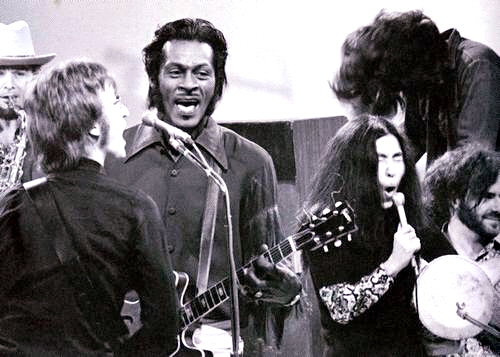
John and Yoko's final Mike Douglas Show appearances were taped January 27th and 28th, 1972. The first of these shows included the most interesting performances of the whole week, when rock and roll icon Chuck Berry joined the panel.
John's schoolboy excitement at sharing the stage with one of his musical heroes was obvious during their two-song set and conversation (Chuck even joined in with a macrobiotic cooking demonstration!). The haphazard renditions of "Memphis Tennessee" and "Johnny B. Goode" proved anticlimactic, but Chuck liked the backing of Elephant's Memory enough to use them on his 1973 album Bio.
On the evening of January 27th, John and Yoko were interviewed by John Wade, for Philadelphia radio station WIBG. Wade had covered previous Beatle tours for WDRC-AM, and had recently interviewed George Harrison (anyone got a tape of that?). The conversation begins with similar topics to the Howard Smith interview four days prior, but touches on the problems with booking controversial guests during their week with Mike Douglas. Wade also talks about playing copies of "Attica State" and "Luck Of The Irish" on his radio show, and John says they were recorded "in bed", so presumably the VPRO versions were circulating in the US by now.
The final Mike Douglas Show appearance was the blandest of all, with no overtly political guests or avant-garde happenings (although "God damn" was bleeped from a rendition of "Luck Of The Irish"). John took questions from the studio audience, talking a bit about the Lennon-McCartney feud which both sides were now eager to put behind them. A pleasant and low-key way to end the week was with Yoko singing a Japanese folk song, "Sakura", accompanied by her husband on acoustic guitar:
John and Yoko's guest hosting week was aired in most US markets the week of February 14th through 18th and went off without any backlash from sponsors or viewers. Certain eyes in Washington DC, however, had been monitoring the Lennons' every move for the last few months, and things were about to get ugly.
Tuesday, May 15, 2012
14 Tracks Per Side
John and Yoko's Mike Douglas Show tapings continued on January 18th and 20th, 1972, in Philadelphia. Each show had a controversial guest booked: radical Jerry Rubin on the first and Black Panther Bobby Seale on the second, and Rubin in particular chose to make several outrageous statements which couldn't have endeared John and Yoko to middle America. The highlight of both days was John's rendition of "Imagine" on the 20th, backed by Elephant's Memory:
January 23rd, 1972 was "Beatle marathon day" on WPLJ, with 17 continuous hours of Beatle music and programming. John and Yoko listened in during the afternoon, and were still tuned in when Howard Smith dropped by to tape an interview for airing at 10pm. The result was a unique opportunity to hear John react in real time to blasts from his past, recalling (and often misremembering) bits of trivia about each song for Yoko and Howard.
Among the recordings heard are Fan Club Christmas messages from 1963 and 1965, Eleanor Rigby, A Hard Day's Night, Back In The USSR, Rain, I'm A Loser, Maybe I'm Amazed, It Won't Be Long, Happiness Is A Warm Gun, She Loves You, I Should Have Known Better, Strawberry Fields Forever, Why Don't We Do It In The Road, All My Loving, A Day In The Life, Something, Tell Me Why, Magical Mystery Tour, Day Tripper, I Wanna Be Your Man, I'll Cry Instead, Hey Jude, Sgt. Pepper's Lonely Hearts Club Band, Bungalow Bill, and The Fool On The Hill.
Other topics included American vs. British television, the recent Mike Douglas tapings, Arthur Janov, and plans for a new album with Elephant's Memory, as well as their accumulating stockpile of live recordings.
New York Beatles fan Dave Morrell had phoned in to Howard Smith's "radio happening" with John and Yoko on June 6th, 1971; later that year he had picked up a copy of the bootleg Yellow Matter Custard. Curious as to the source of these mysterious recordings, he wrote to Smith, asking if he could perhaps put the question to John sometime.
To his astonishment, Smith called a few days later, saying John had read the letter and wanted to meet Morrell. So on December 7th, 1971, Howard and Dave dropped by the Record Plant, where sessions for David Peel's album were ongoing. Along with some other memorabilia, Dave brought a reel-to-reel copy of Yellow Matter Custard, which he presented to John. In exchange, John traded his personal copy of the "butcher cover" of Yesterday And Today (actually a blank cover with the butcher slick pasted on), which he promptly signed, dated, and adorned with a drawing!
Upon hearing the tracks, John deduced incorrectly that they must be the failed Decca audition tapes, and they were played as such when Morrell dropped by the studio later on the night of January 23rd.
Monday, May 14, 2012
Live From Germany

no label, 1972
This is a copy of a Beatleg from late 1971, The Beatles Last Album. The BBC Radio material (from a Top Of The Pops transcription disc) and Smothers Brothers performances were new to boot, and the rest was from common sources (including the non-Beatles tracks by "John and Paul"). None of it is live from Germany, of course.
- People Say
- I'm Walking
- Hey Jude
- Revolution
- The Beatles' Seventh Christmas Record (excerpt)
- Long Tall Sally
- A Hard Day's Night
- Things We Said Today
- Shout!
- Pantomime: Everywhere It's Christmas (excerpts)
- Christmas Time (Is Here Again) (excerpts)
- Sie Liebt Dich
Thursday, May 10, 2012
Dutch Treat
Here's a special bonus post, featuring a recording I just stumbled across. It has much in common with the "born in a prison" 1972 New Year's Message, and stems from around the same time.
Soon after meeting Paul and Linda on December 15th, 1971, John and Yoko were interviewed at their Bank Street apartment for Dutch radio by Ineke van den Bergen. The topics are familiar for the period: his feud with Paul, the Rock Liberation Front, David Peel, Jerry Rubin, etc. There's also a message to prisoners which apparently aired on the Joe Blow Show, a program for Dutch inmates, in a segment called "Jail Cats Corner".
What sets the interview apart is the inclusion of exclusive acoustic runthroughs of "Attica State" and "Luck Of The Irish". At John's insistence, they were marred by voiceover during the original VPRO broadcast on January 7th, 1972. This attempt to foil bootleggers didn't work, as the tracks were booted four years later on the LP Angel Baby. However, those were awful quality, while this recent upload is in mint condition (although still partially obscured).
UPDATE: Thanks to John McEwen for pointing out this page which has clean versions of both songs, from the Joe Blow Show:
http://content1b.omroep.nl/b98edfdfcca1109b0f6b2da1cee09126/4fad212c/vpro/radio-archief/010NB1442_John_Lennon_en_Yoko_Ono_.mp3
Love Calls
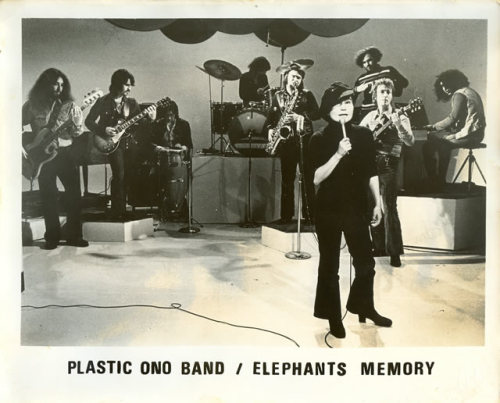
John and Yoko kicked off 1972 with a less-than-cheerful New Year's Message (particularly Yoko's segment). Two events early in January would chart their course for the next few months. First, Yoko appeared solo on the syndicated Mike Douglas Show, taped in Philadelphia (broadcast January 17th in most areas). Along with Mike and his co-host for the week, Robert Wagner, Yoko made "Love Calls" to various citizens chosen at random out of the Philly phone book, telling the unsuspecting strangers they were loved.
Douglas made an offer to Yoko and John to co-host an upcoming week of shows with him, and they jumped at the chance to effectively take over an entire week of American middlebrow television, spreading their political and musical messages. Around this time, they also hooked up with a New York band, Elephant's Memory, who would supersede David Peel and the Lower East Side's role as sideman (and eventually as Apple artists).
After a week or so of rehearsal with the band, it was off to Philadelphia on January 14th to tape the first of five Mike Douglas shows that would air during Valentine's week. In addition to more "Love Calls", they talked about Yoko's conceptual art, and John performed "It's So Hard" with Elephant's Memory (and the ever-present Jerry Rubin). Other guests included consumer advocate Ralph Nader, comic actor Louis Nye, and soul band the Chambers Brothers:
Other than the conceptual art pieces, nothing in the first show was controversial or even out-of-the-ordinary for American TV. The next two appearances would push the envelope a bit further.
Wednesday, May 9, 2012
Living With The Cockaroaches
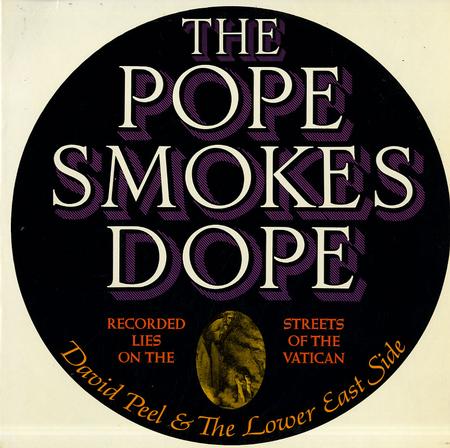
John added a few more pages to his FBI dossier by appearing on the syndicated David Frost Show on December 16th, 1971. He and Yoko had been spending much of December producing an Apple LP, The Pope Smokes Dope, for street musician David Peel and his band, the Lower East Side.
Naturally, they brought the band with them for their appearance, and joined in with the opening and closing numbers, "The Ballad Of New York City/John Lennon-Yoko Ono" and "The Hippie From New York City". Jerry Rubin, who had wreaked havoc on Frost's show a year earlier, was also there but wisely kept his mouth shut.
The trouble began when John and Yoko sang "Attica State", which drew the ire of two audience members who accused the Lennons of glorifying prisoners. After a spirited debate, which included a sample chorus from "Luck Of The Irish", Yoko performed "Sisters O Sisters". It was then her turn to complain, accusing Frost of giving her famous husband more airtime on what was supposed to be her forum.
John also performed "John Sinclair", after gleefully announcing that Sinclair had been released. The show was broadcast January 13th, 1972 and survives on video. Here is the soundtrack to a truncated 1997 airing on VH-1 (including all the music and most of the interesting chat).
Far more dignified was their appearance the following night at a benefit at the Apollo in Harlem to benefit the families of the Attica prison riot. Naturally, they played "Attica State" as well as "Sisters O Sisters" and a beautiful acoustic rendition of "Imagine":
John and Yoko's Christmas was spoiled when Tony Cox, now living in Houston, refused to allow them to see Kyoko. After being jailed for contempt of court and released on bond two days before Christmas, Tony and his wife Melinda fled with Kyoko for parts unknown. Worse was yet to come for the Lennons in 1972.
Tuesday, May 8, 2012
Aminals In The Zoo

Paul and Linda began December 1971 with a brief vacation in Jamaica, and then flew to New York to meet up with the other members of Wings for rehearsals and promotion of Wild Life (issued December 7th in the US).
The group appeared live on WCBS radio December 15th for an interview with Ed Williams. Although he was reluctant to talk about the legal troubles and feuds surrounding his ex-bandmates, Paul did reveal that he had met with John "this very evening". In addition to tracks from Wild Life, Paul and Linda spun a number of reggae singles brought back from Jamaica, as well as Badfinger's new single "Day After Day".
They also premiered a new Wings instrumental, "The Great Cock And Seagull Race", which, based on its appearance on the new Ram reissue, may have been recorded early in the year and overdubbed/remixed in December. Although it remained unreleased at the time, it was being considered as a single B-side.
One potential A-side, "Mary Had A Little Lamb", was rehearsed that month by Wings at the New York headquarters of MPL. WRKO radio visited the sessions, capturing a bit of the rehearsal and taping interviews with the band for a special, Paul McCartney Now, broadcast January 13th, 1972.
In the end, no single was released to accompany the album (although "Love Is Strange" was nearly issued in the UK), and despite the promotion, bad reviews and word-of-mouth kept Wild Life out of the top ten in the UK (it peaked at #10 in the US).
Monday, May 7, 2012
Set Him Free!

John and Yoko's radical activism phase went public in a big way in December, 1971. Sometime during the first week of the month, their Bank Street apartment was visited by a film crew from France's ORTF, shooting an interview for the TV series Pop 2.
Jean François Vallée interviewed the couple in their bed, alongside Jerry Rubin, and John was clearly caught up in the "Rock Liberation Front" movement, railing against capitalism, "British Imperialist pigs" in Northern Ireland, and espousing the immediate release of prisoners across the USA. Luckily, he also had his dobro in hand and treated viewers to some off-the-cuff renditions of new songs "Free The People" (later fleshed out as "Bring On The Lucie") and "Attica State", as well as Bob Dylan's latest single, "George Jackson".
The interview was aired in two parts, on January 8th and January 22nd on ORTF (they can be viewed here and here). While the French broadcast is generally marred by translation, some of the interview was used without voice-over in a British TV show, Aquarius, transmitted on LWT March 11th, 1972.
One cause John mentions in the interview is an upcoming rally to benefit poet/activist John Sinclair, then serving a ridiculous 10-year sentence in Michigan prison for selling two marijuana joints to an undercover officer. John and Yoko, along with Jerry Rubin and David Peel, flew to Ann Arbor on December 9th to participate in the concert. Sometime during their stay (perhaps that night), John was recorded in a hotel room with folk singer Phil Ochs, also on the bill. At Rubin's request, Ochs ran through his song "Chords Of Fame", accompanied by John on the ever-present dobro.
The concert took place the night of December 10th at Crisler Arena. John and Yoko topped the bill, finishing off the concert (accompanied by Peel and his band) with four then-unreleased politically-based songs, including "John Sinclair", penned specially for the occasion:
While the concert may not have been an artistic triumph, it did the trick, as three days later, Sinclair was freed from prison when the Michigan Supreme Court ruled the state's marijuana law unconstitutional. This victory only further convinced John Lennon of the righteousness of the path he was heading down, and shaped his actions for the next few months (which would cause him untold problems with the Nixon government).
Friday, May 4, 2012
Bip Bop Baby

George continued promotion for Raga and the Concert For Bangla Desh LP (finally released December 20th in the US) with back-to-back appearances on chat shows in New York.
First up was The Dick Cavett Show, taped November 23rd (the night after Raga's premiere). Cavett had a much harder time getting George to open up than he had with John, although George warmed to the topic of Capitol Records' president Bhaskar Menon, and EMI's delaying of the Bangla Desh LP for what he perceived as greedy reasons. George also sat in on a song with Gary Wright and watched Ravi Shankar perform, as well as screening clips from Raga and the in-progress Concert For Bangla Desh film:
The next day, George and Ravi were guests on The David Frost Show, syndicated on American TV December 3rd. George begins this appearance even more reluctant to speak, but by the middle of the show has loosened up, singing snatches of "I Believe", "When The Saints Go Marching In", "Isolation", and even "Bip Bop"! He also introduces guest musician David Bromberg, who performs a song he and George had written the previous Thanksgiving, "The Holdup". And George is even persuaded by Frost to reproduce the first sitar exercise he learned from Ravi!
Unfortunately, the videotape of this show doesn't seem to have survived (only a short silent monochrome clip filmed by a home viewer), but a basically complete audio recording does exist.
Thursday, May 3, 2012
Irish Sitar
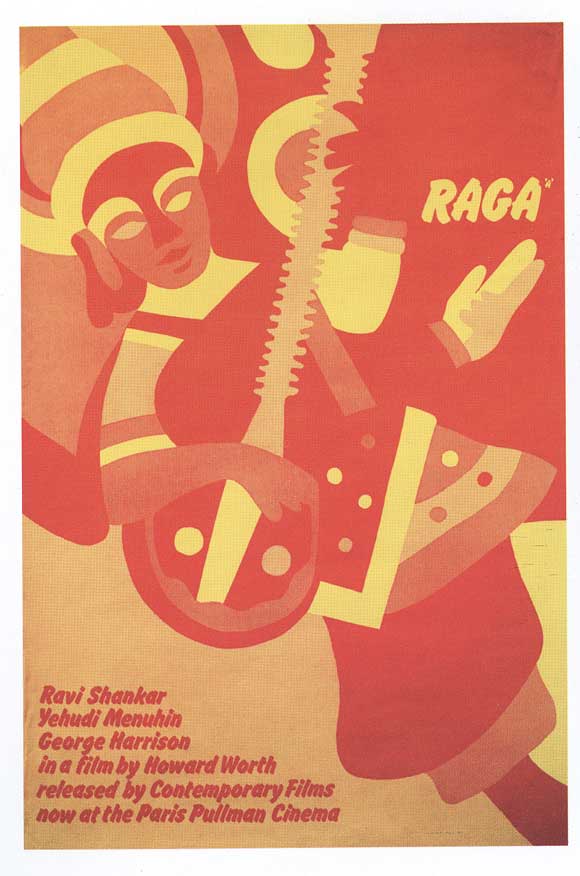 November 1971 was the month of Beatle-related movies, as 200 Motels opened in New York on the 10th, Blindman premiered in Rome on the 15th, and Raga had a special screening at Carnegie Hall on the 22nd, attended by George and John and their wives.
George was in New York all month, editing the film of the Bangla Desh concert and promoting the Raga movie and soundtrack LP. Near the beginning of November (it's introduced as the 7th, but a comment by George places it nearer the 1st), he dropped by WPLJ's studios and talked with Alex Bennett about Ravi Shankar and Indian music in general, as well as his experiences recording Wonderwall in Bombay.
Meanwhile, John and Yoko were entering the "activist/protest music" phase of their career, spurred on by meetings with Jerry Rubin and Abbie Hoffman. As well as producing an album by street musician David Peel, John was writing songs about the Attica prison riot, the jailings of Black Panther Angela Davis and White Panther John Sinclair, and the situation in Northern Ireland.
On November 12th, filmmaker John Reilly videotaped John and Yoko in their Bank Street apartment, working on a new song, "The Luck Of The Irish":
Early versions of "Attica State" and "The Luck Of The Irish" were apparently recorded in the fall of '71 for possible release as a single, or even as part of an LP containing the live Lyceum and Fillmore East concerts. In the end, both numbers were redone during the early 1972 Sometime In New York City sessions with Phil Spector.
Wednesday, May 2, 2012
Straight Babies

As soon as Ram was released, Paul was already considering his next step, and with the thought of going back on the road, he decided to form a permanent band. Beginning with Linda (for moral support more than her rudimentary keyboard skills), Paul retained drummer Denny Seiwell from the Ram session band, and called upon ex-Moody Blues guitarist Denny Laine.
The new group assembled at Abbey Road in August, 1971 to record their debut album, with Paul deliberately keeping the atmosphere loose and undisciplined. The result was perhaps his slightest solo album, Wild Life, containing a Ram leftover ("Dear Friend"), two lengthy jams ("Mumbo" and "Love Is Strange"), a throwaway nonsense ditty ("Bip Bop"), two short instrumental links, and four actual new compositions.
Around the time his and Linda's second child Stella was born (September 13th), Paul devised a name for the band: Wings. He introduced Wings at a launch party on November 8th at the Empire Ballroom in London. Two days later, a Wild Life listening session was held at Abbey Road for members of the press.
One of the reporters, Melody Maker's Chris Charlesworth, taped an interview that day, and rather than introducing his new band and their LP, Paul chose to unload a year's worth of stored resentment at the way Allen Klein and his ex-bandmates had been portraying him since the dissolution lawsuit had begun.
Paul had undoubtedly been hurt by John's song "How Do You Sleep" (on Imagine), and responded to its charges that he hadn't done anything worthwhile since "Yesterday". John had actually written that song partly in response to Paul's veiled attack on him and Yoko in "Too Many People" (on Ram), as he explains in this excerpt from the October 25th David Wigg interview (inadvertantly omitted from the earlier blog post).
In any case, the sniping continued, for after the Melody Maker article was published November 20th, John fired off a point-by-point rebuttal/attack, which was printed in the December 4th issue.
All Paul really wanted at this point was to be rid of Klein's management and set off on his own career, something which he stressed in another November interview with Record Mirror's Mike Hennessy.
Tuesday, May 1, 2012
It's Nothing Important

With their duties in Syracuse finished, John and Yoko returned to their suite at the St. Regis in New York City. On October 25th, they were interviewed there by David Wigg for BBC Radio's Scene And Heard, broadcast over three weeks in November. Here is a 17-minute composite from two separate broadcasts and the raw tape (as released in 1976 on The Beatles Tapes With David Wigg).
John and Yoko went back into the studio with Phil Spector on October 28th, recording their next single at the Record Plant, as well as mixing the live recording with Frank Zappa's band from June. "Happy Xmas (War Is Over)" was released as a single in the US on December 6th, probably too late to take advantage of Christmas airplay, as it failed to chart. It didn't even come out in the UK until the following year, but has grown to become a holiday standard:
During the first week of November, John and Yoko moved out of the St. Regis and into an apartment on Bank Street in Greenwich Village. One of their first visitors was reporter Don Singleton, who was preparing a profile on Yoko for the Daily News. As part of his research, he spoke to John at length (and very candidly and profanely) about the Syracuse exhibit and Yoko's standing in the art world, while builders worked in the background.
Monday, April 30, 2012
This Is Not Here

Yoko Ono's art exhibition, This Is Not Here, occupied the entire Everson Museum at Syracuse University from October 9th (John's 31st birthday) through the 27th, 1971. John and Yoko, along with museum director Jim Harithas, held a press conference at the Hotel Syracuse on October 5th to promote the event.
Yoko also gave some remarks and fielded questions at the museum on October 8th, the day prior to the opening. The next day, John looked on like a proud parent as the crowds explored and participated in Yoko's pieces.
Late that night, John's birthday was celebrated with a singalong party in their suite at the Hotel Syracuse, attended by Ringo and Maureen Starr, Phil Spector, Klaus Voormann, Allan Ginsberg, and Jonas Mekas, who shot a bit of footage:
John, Yoko, and Mekas participated in a bizarre (even by their standards) television show a few days later, apparently to promote the gallery show. Taped October 14th at a Syracuse TV studio, the program was 64 minutes of television without form or narrative, consisting of audience participation pieces culled from Yoko's career, extracts of her films, and exercises from Grapefruit, all tossed together in a surreal fashion. The result was aired on the WNET (public TV) series Free Time, to the bafflement of all:
Thursday, April 19, 2012
Get It On And Rip It Off

Yoko's Fly LP was accompanied by a single, released September 29th, 1971 in the US, which paired two surprisingly conventional numbers from the album: the ballad "Mrs. Lennon" and the rocker "Midsummer New York".
She promoted the new releases in an interview at the St. Regis with WNEW-FM's Scott Muni, who had been interviewing John and his cohorts since their first New York visit in 1964. The first half of the interview is largely devoted to Yoko, but John participates, and takes a larger role in the second half. (Unfortunately, the circulating tape was dubbed on a machine with dying batteries, and speeds up dramatically as it reaches the end).
One of John and Yoko's final film projects was produced in their hotel suite that month. Titled Clock, in best Warhol fashion, it consisted of a one-hour continuous shot of the face of an alarm clock. Its only redeeming factor would have been the soundtrack, consisting of John singing Buddy Holly tunes and other oldies while strumming an acoustic guitar.
Perhaps the film's only screening (no copy circulates at present) was during Yoko's first major American art exhibition, in October at the Everson Museum in Syracuse, NY. John and Yoko talked about the preparations for that event to their old pal Howard Smith of WPLJ radio. The interview also found John defending himself against a number of attacks, both real and perceived, ranging from a letter in the Village Voice, to the lyrics of Ram, to George Martin, of all people!
Wednesday, April 18, 2012
What You Gonna Do Now?
Ringo Starr spent the summer of 1971 in Spain and Italy, co-starring in the ABKCO-produced spaghetti western, Blindman. Ringo played the role of a bandito named Candy, which just happened to be the title of an earlier Ringo movie.
The film premiered in Rome November 15th, 1971 and trickled into theatres worldwide over the next year or so, to poor reviews and minimal attendance. Ringo's only attempt at promoting the film was to compose a dreadful song, "Blindman", and sneak it out on the B-side of "Back Off Boogaloo" in the spring of 1972.
Apart from appearing at the Concert for Bangla Desh, Ringo's other major project that summer was the launching of a home furnishing design company, ROR Ltd., with partner Robin Cruikshank. The duo exhibited their wares that September at Liberty's department store, and Ringo recorded a message promoting the event. He also appeared on the BBC children's show Blue Peter September 16th to show off some of their steel and glass pieces (this footage survives but isn't circulating widely).
Tuesday, April 17, 2012
Betty Rollin's Legs
Once they settled into their suite at the St. Regis Hotel in New York City, John and Yoko wasted no time hitting the promotional circuit. The Imagine LP was released in the US on September 7th, 1971, with Yoko's companion album, Fly, coming out later that month.
On September 2nd, John and Yoko were interviewed by a Japanese journalist about their new releases. With Yoko translating the queries and responses, the 20-minute recording has a minimum of Lennon content, but listen out for his Kabuki impression at the very end!
September 6th found visitors to the St. Regis suite, including George Harrison and Dick Cavett, stepping in front of the camera for the Imagine companion film. Cavett was there to meet the couple prior to interviewing them on his ABC talk show.
The conversation, videotaped September 8th, turned out to be one of John's most entertaining television appearances, and as such over-ran the 90-minute time slot. John and Yoko took up the whole show on September 21st, and a further 25 minutes of leftover material was slotted in on the 24th:
Another early September guest at the St. Regis was writer Peter McCabe, who was working (with Robert Schonfeld) on a book about the dismantling of The Beatles' financial empire, Apple To The Core. Highlights of McCabe's four-hour conversation with John were aired in a 1984 radio special which coincided with the publication of a book containing the full interview, John Lennon: For The Record.
Monday, April 16, 2012
1971 Beatleg Roundup

Other Beatlegs from 1971 covered the by-now familiar "Get Back" acetates (Let It Be - Live), the Let It Be film soundtrack (More Get Back Session), the Hollywood Bowl concert (Shea The Good Old Days), the Shea Stadium concert (Last Live Show), and the Fan Club flexis (Complete Christmas Collection 1963-1969). And the cannibalization had begun: one album paired half of Last Live Show with half of a Rolling Stones bootleg (Battle)!
Sunday, April 15, 2012
Save Us From The Queen

In August, 1971, John Lennon spent his final days in England completing filming of Imagine and lending his name to a couple of causes.
Most conspicuous was his support of Oz magazine, whose editors were being prosecuted under the Obscene Publications Act. John had composed a song, "God Save Oz", recording a demo in April and then producing an Apple single in May, performed by the "Elastic Oz Band" and released as "God Save Us" in July. John and Yoko recorded a quick promo to plug the song for radio play.
On August 5th, a verdict of guilty was handed down for all three defendants, along with a prison sentence (later overturned on appeal). John and Yoko wasted no time in taping a message of support the following day, for airing on pirate station Radio Free London.
On August 11th, John and Yoko joined a protest march in London, not only against the sentences but the British government's recent arrest and internment of 342 people suspected of having ties to the IRA. Both spoke to reporters about their reasons for marching, with John's reply unwittingly sowing the seeds of a future song.
August 12th, 1971 may have been John's final day in his native country. According to his tape archive, he spent part of it with Yoko reading selections from her book Grapefruit, although the recording more likely stems from July, when they were heavily promoting the republication.
Friday, April 13, 2012
Help Us Save Some Lives
One of the highlights of George Harrison's solo career, the Concert for Bangla Desh went from chance remark to superstar benefit in just over a month. In late June, 1971, George was in Los Angeles working with Ravi Shankar on the soundtrack for the long-delayed documentary Raga. Ravi lamented to George about the war occurring in Bangladesh and causing thousands of starving refugees to flood into India from East Pakistan.
George immediately agreed to call attention to the issue by composing a song, "Bangla Desh", hastily recorded and released as a single by the end of July. More importantly, he began rounding up every musical friend he could think of to perform at a charity concert in New York.
Madison Square Garden was booked for two shows on August 1st, and an amazing lineup was assembled, with Ravi himself opening the show and George leading an all-star band including many of the people who had contributed to All Things Must Pass: Ringo, Eric Clapton, Jim Keltner, Billy Preston, Badfinger, Leon Russell, Klaus Voormann, Carl Radle, and of course Phil Spector, recording the show from a mobile unit outside the Garden.
George and Ravi held a press conference at Allen Klein's ABKCO office on Broadway July 27th, explaining the reasons for the concert and the planned album and film, which would generate the bulk of the revenue to be sent as relief aid. Most of the band had only that week prior to the Sunday shows to rehearse, and Eric Clapton didn't arrive until Saturday, with Jesse Ed Davis filling in during his absence (and joining the group onstage).
The already-stellar lineup was given a turbo boost when Bob Dylan, who hadn't toured in five years, agreed to participate, although nobody in the band was certain he would until the moment he walked onstage with his acoustic guitar and harmonica at the matinee performance.
Both concerts sold out almost immediately and raised $250,000, but despite George's press conference prediction of a 6-10 day turnaround for the album to be released, it wouldn't be out until December, with the film delayed even longer; more on that later.
Wednesday, April 11, 2012
The Greatest Book I've Ever Burned

John and Yoko spent early July, 1971 at the Record Plant East in New York, overdubbing and Mixing Imagine and recording tracks for Yoko's companion LP, Fly. They returned to England on July 14th and spent the rest of the month shooting scenes for the Imagine companion film and promoting new product such as the "God Save Us" single and a reissue of Yoko's book Grapefruit.
On the 17th, they taped an appearance for that evening's edition of the BBC1 chat show Parkinson. Host Michael Parkinson was game enough to conduct part of the interview from within a black bag (an experience which Eamonn Andrews and David Frost had earlier declined to participate in), but the line of questioning was decidedly stale.
After three years in the public eye with Yoko, and fresh from visiting freaks and artists in New York, John had to be frustrated spending this entire interview explaining his choice of partner and defending Yoko's concepts to a hostile British press. It's little wonder he would soon make America his permanent home.
Sometime in the latter half of July (possibly during a press day on the 20th), John was interviewed at Tittenhurst for BBC Radio's Scene And Heard. An atrocious off-air tape exists, mostly indecipherable, but topics include a progress update on Imagine, John's reasons for not participating in the upcoming Concert For Bangla Desh, and his opinion of Ram.
John also responds to a rumor published in Disc And Music Echo about a "lost" Beatles single called "Baby Jane" or "Maisy Jones". He assumes they are referring to "What's The New Mary Jane", and even sings a bit of it. If anyone has a better copy of this interview, or can understand more of what's being said, please let me know!
Tuesday, April 10, 2012
The Statue Of Liberty Said "Come"
On June 1st, 1971, John and Yoko landed at Kennedy Airport in New York, where they were met by Apple's Pete Bennett. They had been issued a two-week visa to enter the country in a continuing effort to track down Anthony and Kyoko Cox and settle the custody issue. With no work permit, John was technically not supposed to perform or record any music during his stay, but that turned out not to be the case.
Within a few days of arriving, John and Yoko had managed to make the acquaintance of several notorious radicals, such as Jerry Rubin and Abbie Hoffman, as well as street musician David Peel, in Greenwich Village. On the afternoon of June 6th, they appeared on WPLJ-FM with their old pal Howard Smith, producing a "happening" in which very little of substance actually happened. Imagine "Revolution 9" being performed live for two hours with audience participation in the form of callers, and you'll get the idea. Here is a 36-minute recording of "highlights" from the event.
Smith went from the radio studio to interviewing Frank Zappa in a hotel room, and brought John and Yoko with him. By the end of the conversation, it was decided that the couple should make a surprise appearance at Zappa and the Mothers' show that night at the Fillmore East. John acquitted himself well on an oldie, "Well (Baby Please Don't Go)", and joined in on Zappa's composition "King Kong", which was hijacked to become "Scumbag":
The performance was later released in differing edits on LPs by both Lennon and Zappa. Three nights later, John and Yoko were back on WPLJ radio, this time for a more conventional interview by Alex Bennett, once again taking calls from listeners (and with John having to step out briefly when overcome by nausea).
On June 12th, John and Yoko attended a party at Allen Klein's home, celebrating his wife Betty's birthday. Also attending were Andy Warhol, Miles Davis, Jack Nicholson, and filmmaker Jonas Mekas, who shot some footage:
Friday, April 6, 2012
How Do You Sheep?

Ram sold well enough, topping the UK charts and peaking at #2 in the US (boosted by the #1 single, "Uncle Albert/Admiral Halsey"), but was a disappointment to many fans, and many rock critics tore Paul a new one when reviewing the album.
Paul didn't help matters by refusing to promote Ram at the time. He didn't have a touring band assembled yet, but he also didn't bother with any in-person TV or radio appearances or major print interviews. He and Linda did slap together a couple of home movies and set them to "3 Legs" and "Heart Of The Country" (neither of which were singles). These aired on Top Of The Pops June 24th:
Paul's major promotional idea was to smoke a giant bag of weed, compose an annoying jingle, ramble into a tape recorder, and edit the result together with sheep effects and snatches of Ram songs. He called the result Brung To Ewe By and sent it to undoubtedly puzzled disc jockeys in the form of a 12" disc containing 12 30-second and 3 60-second radio spots.
Other Ram spinoffs included the Muzak incarnation, Thrillington, and a dedicated mono mix of the LP for radio play. All the above plus session outtakes will be included in the upcoming Ram Deluxe package, due out near the album's 41st birthday.
Thursday, April 5, 2012
Comment Dormez-Vous?

John and Yoko spent much of April and May 1971 tracking down Yoko's ex-husband Tony Cox and her daughter Kyoko across the globe. Their travels took them to France, to Majorca, Spain (where the couple were taken into custody briefly after "abducting" Kyoko from her school playground), and to Trinidad and Tobago.
They eventually returned to France on May 14th, this time to attend the Cannes Film Festival, where their films Apotheosis and Fly were in competition. On the 15th, they were interviewed by Pål Bang-Hansen for Norwegian television:
On May 17th, José Arthur spoke with John and Yoko for the ORTF TV show Le Grand Amphi, broadcast June 12th. And at some point during their stay, they recorded an interview for French radio (which unfortunately means most of their responses were buried beneath French translations).
Meanwhile, back at Tittenhurst, recording for Imagine was ongoing, with Phil Spector once again producing, and George Harrison sitting in on a few songs. On May 28th, John and Yoko took a break to record (and film for their own archives) a lengthy interview for BBC Radio's Woman's Hour, on the topics of love and sex.
Monday, April 2, 2012
Growing All The Time

Ringo Starr spent the first week of February, 1971 at Pinewood Studios participating in the filming of Frank Zappa's 200 Motels, in which he portrayed a stylized version of the movie's writer/director/composer:
Ringo's first pop single, "It Don't Come Easy", was released April 9th in the UK and a week later in the US. It rocketed up the charts, peaking in the top 5 on both sides of the pond.
This led to a remarkable situation on April 24th, when all four ex-Beatles had songs in the Melody Maker top 30: "It Don't Come Easy" (#17), Paul's "Another Day" (#14), John's "Power To The People" (#18), and George's My Sweet Lord" hanging on at #28.
The initial promo for "It Don't Come Easy" was a homemade affair, assembled by Ringo from various clips dating back to 1967 and having nothing to do with the song. It was aired on Top Of The Pops April 22nd.
On April 27th, Ringo was in Norway, filming a guest spot on Cilla Black's TV special, Cilla In Scandinavia. Ringo's appearance on a ski slope found him singing the "Snowman Song" alongside Cilla and fox puppet Basil Brush:
While in Norway, Ringo also shot a second promo for "It Don't Come Easy", this time miming the lyrics in between schussing. This version was aired first on Top Of The Pops April 29th, and later as part of Cilla In Scandinavia, broadcast November 27th on BBC-TV.
Friday, March 30, 2012
So Sad

After spending most of 1970 in seclusion at home or in the studio, Paul McCartney found himself back in the headlines as 1971 began, thanks to the case he had filed attempting to dissolve The Beatles' partnership.
His first solo single (credited to Paul & Linda McCartney), "Another Day"/"Oh Woman, Oh Why", was released February 19th in the UK. That same day, he and Linda showed up at the opening day of hearings in the case, at London's High Court. Paul would testify in person on the 26th, and by March 12th, a ruling was made in his favour appointing an accountant, James Spooner, to manage all of the Beatles' assets until the partnership could be legally dissolved. This at least freed Paul from having Allen Klein control his financial destiny.
By then, Paul was in Los Angeles, putting the finishing touches on the Ram LP. He also made an unexpected appearance at the Grammy Awards on March 16th, accepting a trophy for Let It Be:
Meanwhile, John was spending February at his new home studio in Tittenhurst, testing the equipment and doing preliminary recording for the Imagine LP. The first fruit of these labors was the single "Power To The People", released March 8th in the UK. John did minimal promotion for the release, but did chat at home with Kenny Everett around the middle of the month for Radio Monte Carlo. As well as belatedly plugging the Plastic Ono Band LP, John danced his way around the subject of the court case, admitting that it had strengthened the bonds between him and George and Ringo.
Here is a fair quality off-line recording of the interview, broadcast at 1am on the morning of March 28th, as Radio Monte Carlo was about to shut down its English broadcasts for good. This is slightly longer and better quality than the version issued by Black Cat, but still pretty crummy.
Thursday, March 29, 2012
Let's Open The World

While those in the media were left to speculate about how the money would be divided, John and Yoko got away from it all by traveling to Miami and then on to Japan, where John met Yoko's parents for the first time. They stayed at the Imperial Hotel in Tokyo, registering as "Mr. and Mrs. Gherkin".
While managing to duck reporters during most of their stay, they did agree to record a message for Japanese radio before checking out on January 25th. After plugging their new albums ("on Toshiba/Apple"), John answers a few questions about his music, with Yoko translating the queries and responses. The final ten minutes are entirely Yoko speaking in Japanese.
Wednesday, March 28, 2012
The Dream Is Over

Paul waited until the final day of 1970 to file suit against his erstwhile band members, beginning the interminable process of dissolving their business partnership and cementing his role as the "bad guy" in the Beatles' breakup story.
Meanwhile, their solo careers carried on, with Paul spending November and December in New York's Columbia Studios taping the basic tracks for his Ram LP. George was being showered with accolades for All Things Must Pass and "My Sweet Lord", both of which shot to the top of the charts by year's end.
On December 12th, during a break from filming Fly, John and Yoko were interviewed once again by Howard Smith for WABC radio. The conversation touched on many of the same topics as the Rolling Stone interview (John Lennon/Plastic Ono Band, the future of the Beatles, Primal Therapy), John was far more relaxed and less outrageous, perhaps because he knew it would be heard on the radio, or perhaps he had vented enough steam already.
Tuesday, March 27, 2012
Genius Is Pain
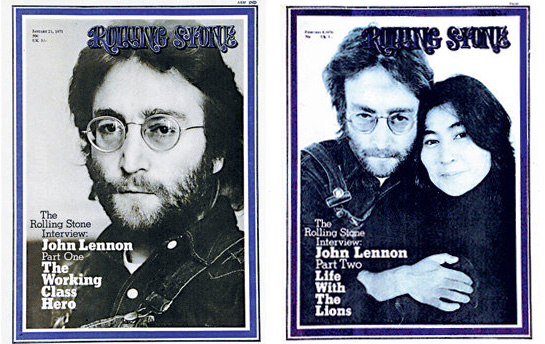
On December 1st, 1970, John and Yoko flew back to America, landing in New York where they would produce a pair of films, "Up Your Legs Forever" and "Fly". More notably, John promoted his new album, John Lennon/Plastic Ono Band, with a marathon interview for Rolling Stone magazine on December 8th.
The interview, conducted by Jann Wenner at ABKCO/Apple's Broadway offices, and given the cover story on the next two issues, was John's first since the Beatles' split, and more importantly his first since undergoing Primal Therapy and spilling out his version of the truth in the lyrics of his new songs. The soul-baring (and self-serving) conversation was soon compiled in a book, Lennon Remembers, but even that was censored to a degree and presented in jumbled form.
Here are the raw tapes of the complete four-hour-plus interview, divided into thirteen segments:
For those who want a more concise summary of the event, try this link.
Monday, March 26, 2012
Back Upon The Shelf

As the Beatles' split was very much 3 vs. 1, it's not surprising that all of the group but Paul continued to work together throughout 1970, particularly once John was back in the country in September.
George had spent all summer working with Phil Spector and dozens of musicians, including Ringo, on All Things Must Pass. He also produced and/or played on sessions for Billy Preston, Doris Troy, and Ashton, Gardner & Dyke. Ringo drummed on Stephen Stills's solo album, and recorded a single of his own, "It Don't Come Easy"/"Early 1970", with help from George and Stephen.
At the end of September, John began recording his own solo album, John Lennon/Plastic Ono Band at EMI. Behind the drum kit was Ringo, and behind the mixing desk for the latter part of the sessions was Phil Spector. When John turned 30 on October 9th, 1970, he was presented with tapes featuring birthday jingles and greetings from other artists, such as Donovan, Janis Joplin, Nina Simone, and Blossom Dearie.
George and the ATMP crew had recorded their own tribute, "It's Johnny's Birthday", the tune lifted wholesale from Cliff Richard's hit "Congratulations". And Ringo and company (including Stills, Preston, and POB bassist Klaus Voormann) refashioned "Johnny B. Goode" into "Happy Birthday John".
This spirit of camaraderie is evident on a recording from the night of October 9th, take four of "Remember", where John is having a blast recording with Ringo and Klaus; when the take is complete, George walks into the studio (he was next door mixing ATMP) and is greeted heartily by all present.
Thursday, March 22, 2012
In Concert At Whiskey Flat

Towards the end of 1970, vinyl Beatlegs not taken from one of the Get Back acetates (or pirated from singles) finally began to surface. Renaissance Minstrels Volume I included songs from the legendary Ed Sullivan shows (sadly, Volume II was just copied from an earlier LP, Homogenized Beatles). Then there was Shea The Good Old Days, lifted from the Shea Stadium TV special.
In October 1970, the nascent Trademark Of Quality label produced another rubber-stamped album with the intriguing title In Concert At Whiskey Flat. The source turned out to be a 1964 concert in Philadelphia, and along with the Hollywood Bowl recording, it was by far the highest-quality live Beatles performance available for the first few years of Beatlegging. It was soon duplicated on albums such as Live Concert At Wiskey Flats and In Atlanta Whiskey Flat.
Wednesday, March 21, 2012
Crazy With Nothing To Do

Like his 1968 pilgrimage to Rishikesh, John's four-month course of Primal Therapy in California may not have been spiritually rewarding in the long run, but it did produce a batch of new compositions of the highest quality.
During his stay from late April through early September, John recorded demos of new songs such as "Mother", "I Found Out", "Love", "God", "Well Well Well", "Look At Me", and "My Mummy's Dead". One such tape, from late July, contains several takes of "God", an unreleased song called "When A Boy Meets A Girl", and a "Poem Game" from Yoko.
Also possibly from the same period is a lengthy recording of John and Kyoko improvising songs and stories (some say it dates from the January 1970 Ålborg trip, but I find it unlikely John had a Rhythm Ace with him in Denmark).
Tuesday, March 20, 2012
Four Knights In Moscow

While John was busy Primaling in America, George spent the summer of 1970 recording the mammoth All Things Must Pass album at EMI and Trident Studios, and Paul remained at home with his family, composing songs for his next LP, Ram.
This left Ringo as perhaps the busiest Beatle that summer, at least in the public eye. He and Maureen attended a screening of the film Woodstock at the Cannes Film Festival on May 9th. After sitting in on some of George's early sessions, he flew to Nashville on June 22nd to record his second solo album, Beaucoups Of Blues. Nine days later, Ringo was back in England and the album was in the can; it was released in September to minimal success.
One of Ringo's neighbours and close friends in Highgate was Bee Gee Maurice Gibb, who had participated the previous year in a "Beatle outfake" recording, the notorious "Have You Heard The Word". Ringo and Maurice spent a few days around the end of August producing a short film for their own amusement. Who Goes There? features brief comedy vignettes in the vein of the Beatles' own Christmas messages of years past:
On October 1st, Ringo taped his second appearance on Cilla Black's BBC1 TV variety series, Cilla, acting in a skit and duetting on "Act Naturally". Although the videotape no longer exists, one fan recorded the audio portion as it was broadcast on February 13th, 1971.
Monday, March 19, 2012
An Intimate Bioscopic Experience

The profoundly anticlimactic film Let It Be premiered May 20th, 1970, simultaneously in London and Liverpool. None of the Beatles attended either British premiere, nor did John attend the American premiere on May 28th. Reviews and box office sales were lacklustre, although it won an Oscar for Best Original Song Score.
The movie was promoted by trailers and commercials of various lengths (60 seconds, 30 seconds, 15 seconds, and 10 seconds). United Artists also issued an unusual one-sided promo single, Dialogue From The Beatles' Motion Picture "Let It Be", which I can't imagine any station adding to its rotation. The final Beatles single, "The Long And Winding Road"/"For You Blue", was issued in the US May 11th and became their final #1 hit on Billboard by June.
BBC Radio aired two specials soon after the movie was released. The first, broadcast May 23rd and entitled Let It Be, examined not only the music from the film, but the group's now uncertain future. The June 27th edition of Film Time featured an interview with Dick Lester about all the Beatles' films, and included vintage 1964 Beatle chats from Movie-Go-Round.
Friday, March 16, 2012
Let It Be

This LP, on the Underground Sounds label, was probably compiled in the period between the release of McCartney (April 20th, 1970) and Let It Be (May 18th, 1970), as it lists the correct title for "Teddy Boy" but merely guesses at "For You Blue" ("Sweet And Lovely Girl"), "Two Of Us" ("On Our Way Back Home"), and "Dig A Pony" ("All I Want Is You").
The contents are lifted from another early Beatleg, Get Back To Toronto, minus a couple of tracks and supplemented by recent singles ("Instant Karma!" and "You Know My Name"). It's similar to another LP of the era, Homogenized Beatles.
- I've Got A Feeling
- Let It Be
- Don't Let Me Down
- For You Blue
- Get Back
- The Walk
- Christmas Time (Is Here Again)
- Teddy Boy
- Two Of Us
- Dig A Pony
- Instant Karma! (We All Shine On)
- You Know My Name (Look Up The Number)
Thursday, March 15, 2012
It's Really A Pity

On April 23rd, 1970, George and Derek Taylor flew to America for a 12-day visit, attending to business at Apple's newly-opened New York office on Broadway. George also dropped by Columbia Studios on May 1st to sit in on a recording session with Bob Dylan.
The following day, at the Apple office, George sat down with Village Voice reporter Howard Smith for a lengthy interview, aired on WPLJ radio. Naturally, the focus of the conversation was the future (or lack thereof) of the Beatles as a working group. George is surprisingly optimistic, refusing to rule anything out, while Smith remains skeptical that they will be able to repair the obvious rift between Paul and the others. After sharing his opinion on the McCartney LP, George reveals that he's preparing to begin recording his own solo album with Phil Spector in a few weeks.
John and Yoko had also planned to begin cutting an album with Spector that spring, but Primal Therapy with Arthur Janov effectively moved everything else in their lives to the back burner for a few months. They also flew to America on April 23rd, settling in Los Angeles where they would undergo a course of therapy that would keep them out of the spotlight through the spring and summer.
Meanwhile, the "Let It Be" single was topping charts around the world, promoted by a clip similar, but not identical to that seen in the movie Let It Be. In addition to airings on the UK's Top Of The Pops (March 5th) and Germany's Beat Club (March 28th), "Let It Be" also cropped up on the Australian series Hit Scene May 2nd, along with brief looks at the Wedding Album and Hey Jude LPs:
Subscribe to:
Posts (Atom)