Thursday, October 11, 2012

Soundstage Of Mind


With Walls And Bridges now finally in his rear-view mirror, John could focus on completing his oldies album. Having realized that only a few of the songs taped with Phil Spector were salvageable, he reenlisted the Walls studio band to record the rest of the tracks.

The musicians spent October 18th and 19th rehearsing the material at a farm in upstate New York owned by music publisher Morris Levy. Levy's company, Big Seven, owned the rights to Chuck Berry's "You Can't Catch Me", a lyric from which Lennon had appropriated in "Come Together". As part of an agreement with Levy, John agreed to record some songs from the Big Seven catalog in his oldies project.

In exchange, Levy loaned the band use of his dairy in Ghent for the rehearsals, which were recorded. Among the numbers tried out were several that didn't make the final cut, including "Thirty Days", "C'mon Everybody", and "That'll Be The Day":


The band made quick work of the sessions at the Record Plant in New York, completing the basic tracks for the rest of the album in five days of sessions from October 21st through the 25th. Overdubbing and remixing continued through November.

On the other side of the country, George was rehearsing his own band for the Dark Horse tour, scheduled to begin November 2nd in Vancouver. George officially launched the tour during a press conference October 23rd at the Beverly Wiltshire Hotel in Los Angeles. His comments about "going back in his cave for another five years" foreshadowed the troubles ahead.

The truth was that George had been simultaneously rehearsing on a soundstage at Hollywood's A&M Studios and still recording the Dark Horse LP throughout October, with sessions running as late as the 31st. The result was an album and tour marred by George's croaky, raspy vocals, as heard in this promo clip for "Dark Horse" filmed during rehearsals:


Wednesday, October 10, 2012

That's Entertainment


Believe it or not, John Lennon wasn't the only ex-Beatle doing things in the early autumn of 1974.

Two songs from Paul McCartney and Wings' Nashville sessions were released as singles in October. "Walking In The Park With Eloise", credited to the Country Hams, came out October 18th in the UK (on EMI, not Apple) and unsurprisingly failed to chart anywhere. "Junior's Farm", backed with "Sally G", fared much better. It went on sale October 25th in the UK (where it peaked at #16), and November 4th in the US, which took the A-side to #3 and then found the B-side creep into the top 40 when it was promoted as a country crossover.

Ringo had spent most of the summer recording Goodnight Vienna, which received final overdubs and mixes in September and October. He also worked on a live action/animated film with Harry Nilsson, Ringo And Harry's Night Out; it was never completed, but brief glimpses were seen in the documentary Who Is Harry Nilsson?

Inspired by Dark Horse, Ringo was in the process of starting his own label, Ring O'Records. Its first signing was David Hentschel, who had been an engineer at Trident Studios (working on All Things Must Pass and Red Rose Speedway) before branching out into music. He played synthesizer on numerous albums, and Ringo commissioned him to record a synth-based remake of the Ringo LP (akin to Paul's Thrillington remake of Ram). This odd project was taped during September 1974 at the home studio Ringo had installed in Tittenhurst after buying it from John. Startling Studio provided the LP's name (Sta*rtling Music), and Ringo reprised his role of finger clicks on the cover of "Step Lightly". Phil Collins played drums on several of the songs:


George was running himself and his throat ragged recording the Dark Horse LP, working with Ravi Shankar, and rehearsing his own band for a US tour, the first by an ex-Beatle. At some point, he sat down by a roaring fire at his Friar Park home with DJ Alan Freeman and recorded a lengthy interview for syndication on the US series Rock Around The World.

The exact recording date is uncertain, as the show was apparently first aired in October 1975 to promote Extra Texture. But there is no mention of that album, and George plays solo acoustic renditions of both sides of the first US single from the 1974 LP ("Dark Horse" and "I Don't Care Anymore"). He also drops in brief performances of "Awaiting On You All" and "Far East Man" in response to Freeman's questions.

Most of George's replies early in the conversation ("force-grown rhubarbs in a hothouse", "if there's a God, we must see Him", "Ravi's the only person I met who impressed me") will be familiar to interview collectors, but as time passes, George opens up about his inspirations ("One Meatball", Buddy Holly, "Heartbreak Hotel"), calls Beatles songs "80% overrated" but explains how they revolutionized studio recording, touches on his recent separation from Pattie, and in one breath claims that Paul "ruined" him as a guitarist, and in the next talks of how he and Paul have recently begun to reconnect as friends and enthuses about doing the same with John as soon as possible.

Speaking of John, he had one last bit of promotion to do for Walls And Bridges, namely shooting a promo clip for "Whatever Gets You Thru The Night", which was rapidly climbing the US charts, to be shown on Top Of The Pops. On October 17th, John and a BBC film crew wandered around New York filming John's interactions with fans and kids in Central Park.


Thirty years later, the raw footage was re-edited to create a video for the 1973 song "Mind Games":


Friday, October 5, 2012

New York Talk


John Lennon spent the first half of October, 1974 in pre-production for the Rock And Roll LP. Having retrieved the tapes from the late 1973 Phil Spector sessions, he spent several days in the Record Plant listening to the material, remixing and editing and overdubbing (for instance, replacing his drunken lead vocal on "Just Because" with a fresh take that referred to the New York studio).

After celebrating his 34th birthday, John took one final lap in the Walls And Bridges promotional marathon. On October 10th at Capitol Records' New York offices, he spoke with Jim Ladd for the syndicated radio series Innerview. The finished broadcast includes plenty of Lennon and Beatles songs, and finds John reflecting on broad topics such as peace, philosophy, drugs, meditation, charity, and art. Another recording dated October 10th circulates, labeled Rock World, that mostly overlaps this one (which may indicate Ladd's interview was used in other shows); here is a unique bit from the alternate source.

On October 11th at the Record Plant, John took a phone call from Australia (showing up late to the 2PM appointment). This interview, with John O'Donnell of Melbourne's 3XY Radio, was more prosaic than the Innerview, basically describing each song on Walls And Bridges track-by-track. The interview exists in two forms: a very good quality (but heavily truncated) broadcast with O'Donnell's original questions, and a lesser quality (but complete) airing on Sydney's 2SM, with disc jockey Ron E Sparks dubbing in the questions. I've combined both sources into a full composite; John also read a station ID for 3XY, plugging "Rocktober".

Wednesday, October 3, 2012

Many Vicissitudes


John's promotional campaign took an odd turn on October 3rd, 1974 when he visited the New York headquarters of ABC Radio. He was there to appear on media icon Howard Cosell's syndicated talk series, Speaking Of Everything.

In typically loquacious fashion, Cosell elicited thoughtful conversation from John about his immigration case, the Beatles as cultural leaders, the state of relations among the ex-group, and intellectualism in music. John and Howard got along so swimmingly that John agreed to appear on Monday Night Football a couple of months later.

Meanwhile, John was still phoning disc jockeys across the USA to plug the new album and single. Sometime during late September-early October (exact dates unknown), he chatted with Ginger Sutton at WEBN in Cincinnati and John Houghton of WZMF in Milwaukee. The latter interview is particularly interesting, covering musical influences, John's acceptance of his Beatle past, the Plastic Ono Band album, comparisons with Van Gogh, Dylan Thomas, and Brendan Behan, his Dick Cavett Show appearances, Allan Klein, reunion rumors, and his current feelings about Yoko.

Monday, October 1, 2012

Listen To This Blog Post


After appearing in local markets from California to Texas to Canada, John Lennon finally appeared live on his hometown radio. Late in the afternoon of September 28th, 1974, he showed up at WNEW-FM's studio for a surprise appearance during Dennis Elsas's Saturday shift.

Armed with a stack of singles, John spent the next two hours spinning tracks from Walls And Bridges, and deconstructing songs old and new by Bobby Parker, ELO, Marvin Gaye, Harry Nilsson, Splinter, Ringo Starr, Richie Barrett, Ray Charles, the Rolling Stones and Derek Martin, often playing "spot the influence".

The tape has been rebroadcast with some regularity over the years, and most of it was included in the Lost Lennon Tapes radio series; here is the complete broadcast (minus commercials):

Hour 1
Hour 2

Walls And Bridges was officially released in the US on September 30th, trailed by an extensive promotional campaign consisting of radio and TV ads, buttons, billboards, posters, matchbook covers, T-shirts, bumper stickers, and more, all labeled "Listen To This [X]":


Thursday, September 27, 2012

Flight Of The Butterfly


September 27th, 1974 saw two McCartney-related titles go on sale in the UK.

First was the LP McGear, which Paul and members of Wings had worked on at the beginning of the year. Paul had co-written most of the numbers with his brother Michael, and played and sang backing on many of the tracks.


Released the same day was Rod Stewart's album Smiler, featuring the song "Mine For Me". Paul had written it specially for Rod and added a harmony vocal.


Also in stores (released September 20th in the UK) was Adam Faith's new LP, I Survive. Paul contributed synthesizer parts to four numbers (uncredited on the sleeve), singing backup on one of them, "Star Song":


Last but not least was Peggy Lee's album Let's Love, released October 1st in the US. Paul had brought the title song to a dinner with Peggy as a gift (in lieu of a bottle of wine) and played piano on the track, recorded in Los Angeles during the spring.


John Lennon was not idle on September 27th, either, continuing his Walls And Bridges radio phone-ins with a call to Mark Parenteau at WABX in Detroit. The two chatted about John moving to Toronto (a false rumor spurred by his CHUM interview the previous day), "Steel And Glass", Aunt Mimi, the UFO sighting, and Eddie Lawrence, the performer who had narrated the Pussycats TV spot.

Also dated September 27th (I'm not sure if it's the recording or air date) is John's appearance on BBC Radio One's Rock Speak. Tape of a Lennon interview was played, with DJ Michael Wale overdubbing the questions; topics covered include nostalgia, the inaugural Beatlefest, Mind Games, and a track by track description of the new LP.

Wednesday, September 26, 2012

It Was 38 Years Ago Today


Thus far, John Lennon's promotional radio tour for Walls And Bridges had taken him to Los Angeles and San Francisco. Rather than continue to drag himself across North America, he consolidated his efforts by doing phoned-in interview appearances with FM stations from his base in New York, taking 10 or 20 minutes to talk with disc jockeys in major markets.

On September 26th, 1974, John's busy day began at Capitol Records' offices, where he spoke with EMI's British managing director, Bob Mercer. The recording was meant for the ears of EMI's sales staff, to inspire the troops in promoting the new single and album; it was pressed as a white-label promo single (with "Whatever Gets You Thru The Night" on the flip) and included on the remastered Walls And Bridges CD.

John then sat down at the telephone and began doing the radio phone-ins. First up was WMMS-FM in Cleveland, whose Denny Sanders asked John about the latest trends in lavish rock stage and studio productions, his duet with Julian on "Ya Ya", the chances of doing benefit shows, and the recent Beatles fan conventions held in Boston and New York.

For Toronto's CHUM-FM, John talked about paying taxes, choosing musicians for his projects, his trip to Colorado to record with Elton John, his UFO sighting, and most interestingly, the status of his relationship with Yoko, which he sums up as "we're just good friends".

Alan Stone from WQRS in Minneapolis also spoke with John; their conversation touches on Little Richard, driving across the USA, immigration, Elephant's Memory, Badfinger's new album, and John's imminent 34th birthday.

PS: I've realized that the mysterious "1975 RKO interview" I posted yesterday actually consists of excerpts from the 1977 RKO radio documentary series From Liverpool To Legend. I do have this in better quality, so I may post John's interview pieces again when I get to 1975 (or 1977).

Tuesday, September 25, 2012

Bloody Giraffes


OK, here's a bit of a puzzler. I had this John Lennon interview identified as an RKO Radio broadcast from September 25th, 1974.

It circulates in two versions: here is the unedited recording, complete with questions, from a rebroadcast in 2005 (on Black Cat's CD Oh Yeh?). There is also a much shorter and lower-quality version, with questions removed and music included, presumably from the original airing.

Internal clues date the interview to the first few days of August 1974. So far so good, right?

Well, there is another interview out there claiming to be a September 25, 1974 RKO broadcast. It does indeed contain a couple of snippets from the above (which I have removed). But the bulk of it seems to be from a completely different date (or dates), possibly 1975, based on the reference to Allan Williams' book. Several pieces of it will be familiar to viewers of the Beatles Anthology documentary.

Can anyone clear up just what was recorded and/or broadcast when and where? We may have to wait for Lennonology to solve this mystery.

Monday, September 24, 2012

Len & Horses


Let's see, where were we...


Oh yes! John Lennon was in the first stage of a massive media campaign promoting his new album, Walls And Bridges. The first single, "Whatever Gets You Thru The Night" came out September 23rd, 1974 in the US, with the album following a week later. On September 21st, John traveled from Los Angeles to San Francisco and stopped by KSAN-FM to appear during Tom Donahue's evening shift.

In addition to plugging the album heavily, John played a number of songs by other artists, old and new, often to illustrate a musical point or highlight some of his newer favorites. During the three-hour show, John talked about the title and cover art of Walls And Bridges, his work with Phil Spector, his invitation by WNET to introduce Monty Python's Flying Circus, the deportation case, George's upcoming tour, recording Sgt. Pepper, Doc Pomus, and the Maharishi.


Speaking of George, back in England he was busy starting up his new record label, Dark Horse, officially launching the project with a press conference on September 6th. He had begun to record his solo LP of the same name back in the winter of 73-74, but most of the sessions took place in a rushed fashion during August and September amidst other projects.

The most important to George was producing an album and arranging a concert tour for Ravi Shankar and a host of Indian musicians. His home studio, FPSHOT, was used to record the LP Ravi Shankar's Music Festival From India (eventually released by Dark Horse in 1976), as well as being a base for tour rehearsals.

On September 23rd, the concert at London's Royal Albert Hall was filmed by Dark Horse, with George present to introduce the proceedings:


Wednesday, August 22, 2012

Karate Chaos In The Backyard


Following their successful Nashville trip, Paul decided to continue rehearsing the new Wings lineup in London, this time in the familiar surroundings of Abbey Road's Studio 2.

With Geoff Emerick engineering and an MPL camera crew filming the proceedings, Paul, Linda, Denny, Jimmy, and Geoff ran through 20 or so numbers. Shooting actually began August 24th with Paul performing a solo acoustic set in the Studios' small garden courtyard. The result was a short film which came to be known as The Backyard:


None of the backyard footage was used in the completed hour-long production, titled One Hand Clapping. Live band performances were shot on August 27th and 28th, including this smoking version of "Soily":


Paul bookended the filming with another solo set on August 30th, this time at the piano:


One Hand Clapping was never screened in finished form, although most of it was included on a bonus DVD with the 2009 Band On The Run remaster. The Yellow Cat CD featuring excellent stereo mixes from these sessions is a must-listen, showcasing Wings at its tightest, performing some of Paul's best material.

Back in America, John was about to begin the biggest promotional push yet for any of his solo albums, and his most concentrated series of media appearances since the Bed-in days. The Walls And Bridges blitz began in Los Angeles early in the morning of September 20th. KHJ-AM was hosting "Superstar Week", with a different celebrity filling in each day for DJ Charlie Van Dyke.

John was the Superstar for the Friday slot, and managed to drag himself to the studio at 6AM (or perhaps he just stayed up all night) to begin the morning shift. His energy level remained high for the next 2.5 hours as he took requests and chatted with callers, did time checks and read local ad copy, and plugged the new album by spinning several tracks and airing a specially-taped radio spot he'd done with Ringo a couple of weeks prior.

Later on the 20th, John spoke via telephone to his old pal Kenny Everett, now working at Capital Radio in London. It would be Kenny's last interview with John.

Tuesday, August 21, 2012

At The Starting Gate


While he had been typically quiet in the public sphere throughout 1974, George's private life and musical activities had kept him busy. His eight-year marriage to Pattie Boyd had disintegrated following infidelities on both sides, and George found himself alone at home with a lot of time on his hands.

In March, he spent a few days in the studio producing an LP for Ravi Shankar in Los Angeles; Shankar Family & Friends featured short individual songs on one side and an ambitious ballet suite, composed by Ravi, on the other. The first single from the album was the lovely Indian-flavored pop song "I Am Missing You":


On May 23rd, George finalized a deal to found a new record label, Dark Horse Records, to be distributed worldwide by A&M. With Apple now pared back to a bare-bones staff, the company couldn't focus on promoting anything more ambitious than ex-Beatle product. George figured it would be easier to start his own company to cultivate artists such as Ravi Shankar and the duo Splinter.

As we've seen earlier, George had produced a song by Splinter for a film soundtrack, and he was so taken with their ability that he agreed to produce a full album at his home studio, FPSHOT, that spring. George played guitar on nearly every number, and used friends such as Gary Wright, Billy Preston, Jim Keltner, and Alvin Lee to provide musical support. The LP, The Place I Love, was issued on Dark Horse in September, trailed by the single "Costafine Town":


In mid-August, George sat down with DJ Nicky Horne and recorded an interview to launch the Dark Horse label and promote the first two signings. Issued to stations as Dark Horse Radio Special in September, the disc finds George discussing Splinter, the film Little Malcolm, his home studio, the Material World Foundation, the new label, Indian music, and the concept of karma. He also drops a couple of clues to his now-rabid Monty Python fandom by quoting the Lumberjack sketch and making a downright obscure reference to David Niven's fridge!

Monday, August 20, 2012

Surprise Surprise


Once he had moved back to New York and wrapped up the Pussycats sessions, John began to clean up his act. He accompanied Harry Nilsson to a meeting with RCA records executives, strongly insinuating that if they signed Harry, John would not only join the RCA roster when his EMI contract expired in 1976, but might bring some other ex-Beatles with him. The ruse worked, and Pussycats came out August 19th on RCA, accompanied by a TV ad:


Having written a new batch of songs that were his strongest in three years, John was ready to start recording another solo album at the Record Plant. Accompanied by a core band of Jesse Ed Davis on lead guitar, Ken Ascher on keyboards, Klaus Voormann on bass, and Jim Keltner on drums, John ran through all the new material on July 13th and 14th, recording the rehearsals and whipping the arrangements into shape:


Tracking sessions for Walls And Bridges began the following day, and wrapped up in a productive nine days, with overdubbing and mixing continuing into August. Ringo had been in Los Angeles since May recording his new LP, Goodnight Vienna, and John wrote and taped a demo of the title track using the Walls And Bridges band:


On August 6th, John flew back to Los Angeles (accompanied by May, Cynthia, and Julian) to participate in the Goodnight Vienna sessions. As well as playing piano on his own composition, John suggested Ringo record the Platters oldie "Only You (And You Alone)", laying down a guide vocal for Ringo to follow:


John and May left California on August 10th and flew to Colorado, meeting up with Elton John at Caribou Studios, where the latter was recording his LP Captain Fantastic and the Brown Dirt Cowboy. Elton had contributed backing vocals and piano to "Whatever Gets You Thru The Night" and "Surprise Surprise" on Walls And Bridges, and now he and John teamed up to remake "Lucy In The Sky With Diamonds" in a reggae style.

It didn't fit in with the autobiographical concept of Captain Fantastic, so Elton released "Lucy" as a stand-alone single in November, backed with another Lennon cover, "One Day (At A Time)" (from Mind Games). John played guitar on both sides of the single, which shot to the top of the charts, as had most everything from Elton lately:


During all this musical prolificacy, John still had the threat of deportation hanging over his head. In fact, on a taxi ride to the Record Plant July 16th, John heard a radio news bulletin that his latest appeal had been rejected by the INS, and that he once again had sixty days to leave the country. His response was to facetiously tell the cabbie to take him straight to the airport.

Good news came down August 8th while John was in L.A., as Richard Nixon resigned, taking most of the steam out of his administration; all that remained now was for the wheels of bureaucracy to grind slowly to a halt. On August 30th, John appeared in court again; with the widespread corruption of the Nixon government now common knowledge, John and his lawyer Leon Wildes were trying to cross examine high-ranking officials in an effort to prove that the deportation push was politically motivated.

Outside the courthouse, John spoke with reporters about his odds of staying in the US, and afterwards was cornered by some fans with a tape recorder and camera. He posed for photos and sang a bit of "Hello Dolly" before changing out of his "civvies" and heading to the Record Plant to finalize the Walls And Bridges lineup. From this point on, things would only improve in John's life over the next 24 months.

Friday, August 17, 2012

Take Me Down, Jimmy!


On May 23rd, 1974, news leaked that Paul and Wings would be flying to Nashville for a six-week visit to rehearse the new band lineup and record a few numbers. The McCartney clan arrived June 6th, followed the next day by the rest of the group.

They all stayed at a farm owned by songwriter Claude "Curly" Putman, Jr., giving Paul the inspiration to write "Junior's Farm"; its B-side, "Sally G", was influenced by the local nightlife. Paul and family also ventured out during the day a few times, visiting the Grand Masters Fiddling Contest at Opryland on June 16th, where they met Dolly Parton and Porter Waggoner. They also socialized with Johnny Cash at his home.

Recording sessions at Soundshop Studios took place over the first half of July, and produced an interesting batch of songs:


In addition to the "Junior's Farm" single, Paul recruited Chet Atkins, Floyd Cramer, and other local pros to record an instrumental number written by his father, Jim McCartney, back in the 1950's. "Walking In The Park With Eloise" would be credited to the Country Hams when it came out as an EMI single in October.

Wings also recorded a country-tinged Denny Laine composition, "Send Me The Heart", and added overdubs to some earlier unreleased recordings, including "Wide Prairie", "Hey Diddle", and "Bridge On The River Suite" (which ended up as the B-side of the Country Hams single). Paul's plan was to gather the various Wings outtakes and rejects on a budget-priced package called Cold Cuts.

Meanwhile, Band On The Run showed no signs of slowing down; it was in the UK top 20 for every single week of 1974, and hung around the Billboard top 200 until May of 1975. A third potential single from the album, "Mamunia", was dropped in favor of the newer "Junior's Farm", but a promo film was created and aired on ITV in August:


Thursday, August 16, 2012

What's The Use Of Worrying?


Before flying back to London from Los Angeles, Paul received a gold record for Band On The Run, which was proving to be the sturdiest seller in his solo career. It had entered the Billboard chart back in December 1973, and it took until April 13th (helped by the "Jet" single) to reach #1. The title track was issued as a single April 8th, and it too would top the chart by June, bringing the album back up to #1 twice more that summer.

All this success meant Paul had a chance to take a break from recording and touring while he recruited new Wings members and stockpiled fresh compositions. Jimmy McCulloch had already won the lead guitarist role, and after a series of auditions in April and May, Geoff Britton was elected to fill the vacated drummer's seat.

Although Wings issued only one single and no albums in 1974, Paul wasn't exactly hard to find on store shelves if you knew where to look. Back in 1971 during the Ram sessions in New York, he had sat in on bass with singer/guitarist Leslie Fradkin. Paul's contribution to the song "God Bless California" came out June 17th, 1974 on the LP Pass On This Side, credited to Thornton, Fradkin & Unger and the Big Band.

In early '74, during the McGear sessions, Paul also produced and played on a single for the Scaffold, a music/comedy/poetry group Mike McGear had co-founded. "Liverpool Lou" was released May 24th, and climbed to #7 in the UK:


During his and Linda's visit to the US, Paul also dropped by James Taylor's sessions for the LP Walking Man, which came out June 1st. Paul, Linda, and Carly Simon provided backing vocals on two numbers, "Rock 'N' Roll Is Music Now" and the anti-Nixon tune "Let It All Fall Down":


One of Paul's least-known compositions (co-written with Linda) was "4th Of July". It was written at least as early as the spring of 1973 (he strummed a bit of it while taping James Paul McCartney), but ended up being donated to singer John Christie. His version, produced by Dave Clark (of DC5 fame), came out as a single June 28th, perhaps too close to the holiday to make an impact on the charts:


Wednesday, August 15, 2012

Guaranteed To Keep You Alive


Riding high on the success of his Ringo LP, which had just spawned its third top 10 single, Ringo was eager to get back into the studio with producer Richard Perry and his musical mates such as Harry Nilsson to record a follow-up album.

Sessions for Goodnight Vienna would begin at the end of May, 1974, but Ringo was plenty busy in the weeks leading up to them. On March 29th, he and Keith Moon taped an appearance on ABC-TV's In Concert, introducing the UK band Sparks to an American audience. The show was aired November 11th:


On April 14th, Ringo and Keith made a live appearance on KROQ radio in Pasadena, sitting in on the Flo & Eddie Show. Ringo knew the duo from his work with the Mothers of Invention on 200 Motels, and the obviously inebriated drummer sang a bit of his current hit single, "Oh My My", and took calls from befuddled listeners. Legend has it that Ringo came on the show and dropped 14 f-bombs during the first 90 seconds, leading to the show's cancellation, but the truth is a bit less sensational than that.

A few days later, Ringo, Keith, and Harry flew to Atlanta for the long-delayed April 19th premiere of their film Son Of Dracula, which had sat unseen in the can since 1972. To say the film was a flop would be an understatement, as it closed soon after the gala opening night, and rarely showed up on any other movie screens. Ringo (sounding drunk yet again) did a bit of promotion for the movie during an April 27th interview for the Dutch pirate station Radio Veronica, of all places; there's no evidence the film ever opened in Holland.

Meanwhile, John and Harry had been taping Pussycats at the Record Plant, but as events spiralled out of control, they opted to ditch the Los Angeles scene and return to New York, where they could finish the sessions in relative peace. They also decided to counter the negative press their drunken exploits had been receiving with a bit of positive PR.

On April 28th, they appeared briefly at a Central Park rally for the March Of Dimes charity. WABC's Cousin Brucie introduced John and Harry to the throng of marchers, and they sang a bit of "I'm Walkin'" and fielded a few questions from the crowd:


Tuesday, August 14, 2012

Spoiled Soup


On March 8th, 1974, Paul and Linda were interviewed at MPL's offices in London for the US morning news show Today. Scott Osborne conducted the filmed interview, which covered the standard reunion topics and touched on Paul's songwriting technique (using "Picasso's Last Words" as an example). The film was aired in two segments on NBC March 12th and 13th.

A week later, Paul and Linda flew to Los Angeles, where they would attend the Academy Awards on April 2nd (and watch "Live And Let Die" lose to "The Way We Were" for best song, as well as seeing David Niven deal effortlessly with a streaker). Of course, John and Ringo were both in Southern California that spring, stoking the reunion fire once more.

Tired of waiting around for Phil Spector to resume the oldies sessions, John had agreed to produce Harry Nilsson's next album, Pussycats. The duo were already making headlines for their drunken antics, most notably being thrown out of the Troubadour on March 12th for heckling the Smothers Brothers.

There was a large pool of session musicians to choose from in Los Angeles (Spector had used dozens of them the previous fall), and whoever was around the Record Plant on Sunday nights would often join in a loose weekly jam dubbed the "Jim Keltner Fan Club". On one such night just prior to the Pussycats sessions, Mick Jagger was present and decided to cut a song with John producing and the "Fan Club" providing a tight backing. The result, "Too Many Cooks (Spoil The Soup)", remained unreleased until the Very Best Of Mick Jagger collection in 2007:


While that session produced admirable results, there was no better illustration of the adage about too many cooks than the events of March 28th. It was the first night of the Pussycats sessions, and after cutting the first song, a cover of Bob Dylan's "Subterranean Homesick Blues", a drunken (and likely cocaine-fuelled) John and Harry were joined in the studio by Paul and Linda, along with Stevie Wonder.

What could have been a memorable, if not mind-blowing, jam session was spoiled by nerves, intoxicants, and the bizarre decision to stick Paul behind a drum kit. Unable to settle on a song everyone could play, John vented his frustration by bitching about the level in his headphones; his and Harry's voices were pretty shot anyway, and the results of the sole 70's Lennon/McCartney reunion are not pleasant to hear:


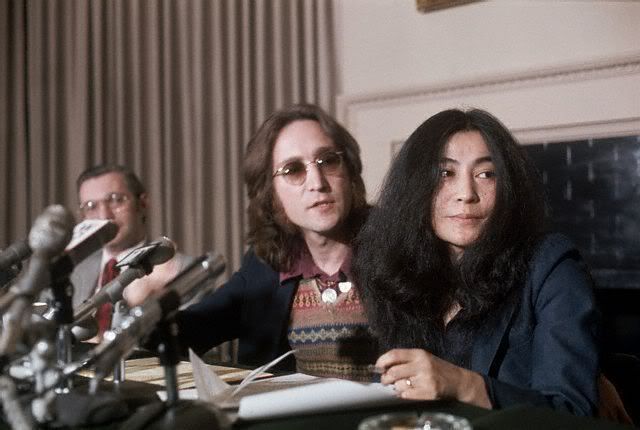
By that time, John and May were living in a beach house in Santa Monica along with Harry, Klaus Voormann, and Ringo (with other musicians and partygoers such as Keith Moon, Mal Evans, and Jesse Ed Davis coming and going at will). Paul and Linda dropped by on April 1st (just missing Ringo's presence), when the above photo was taken. It was the last time John and Paul were photographed together.

Monday, August 13, 2012

Ten Years After at Strawberry Studios


The first single pulled from Band On The Run was "Jet", issued January 28th in the US with "Mamunia" on the B-side, but quickly withdrawn when Paul changed his mind and switched the flip to "Let Me Roll It", matching the UK B-side. The song reached #7 on Billboard and #4 on Melody Maker's chart.

Paul spent the first two months of 1974 at Strawberry Studios in Stockport (just outside Manchester) producing an album for his brother, Mike McGear. As well as writing or co-writing most of the songs on the LP, Paul played bass, guitar, and keyboards throughout. He, Linda, and Denny also provided backing vocals, making it a de facto Wings LP with Mike as the lead singer:


The sessions were also sort of an audition process for the new Wings lineup, as Jimmy McCulloch played lead guitar, and Gerry Conway played drums. On February 7th, Paul spoke via telephone from Liverpool to Jay Stone of KSLQ in St. Louis; despite his assertion during the interview, Gerry Conway would not join Wings, and the search for a new drummer would continue.

February 7th, 1974 also happened to be the 10th anniversary of the Beatles' momentous first arrival in New York, and Capitol Records put together a campaign celebrating the "Beatles Decade". 30-second and 60-second radio spots were produced, along with a TV commercial pushing the group and solo back catalogs.

Friday, July 27, 2012

Lonely Far East Man


After the release of Living In The Material World, George retreated once again from the public eye for the remainder of 1973. One of his only Apple-related projects that year was producing the film Little Malcolm; George had seen the play on which it was based in 1966 and fell in love with the story.

The movie was filmed in February and March 1973 but not released until June 1974, when it was screened at a Berlin film festival. By that time, Apple was nearly defunct as a business, and the film remained mostly unseen until its recent DVD release. George also produced and played guitar on a song for the soundtrack, "Lonely Man", co-written by Mal Evans and performed by the duo Splinter.


As with most of George's musical efforts from this point forward, the song was recorded at his home studio, FPSHOT (Friar Park Studios, Henley-On-Thames). He invited guitarist Ron Wood to stay there in October 1973, and the duo co-wrote a song for Wood's next album, "Far East Man".


In November, George was ready to begin recording his own LP at home, inviting Ringo to participate. He would record his own versions of "Far East Man" and an earlier giveaway, "So Sad", for the album. Very little work on what would become Dark Horse was done by the time George took another trip to India in February 1974.

By that time, Ringo was hogging most of the spotlight as his LP Ringo had been a gold-seller, and the #1 single "Photograph" was followed up in December by another #1 US single, "You're Sixteen". On February 8th, 1974, "You're Sixteen" was issued in the UK (where it peaked at #3). By then, the US was up to its third single from the LP, "Oh My My", which came out February 18th. It reached #5, making Ringo the first (and to date, only) ex-Beatle to have three top five singles from the same LP.

On February 6th, Ringo sat down with Brian Matthew for an appearance on the BBC Radio 1 series My Top Twelve. As the title suggests, the show was an outlet for celebrities to choose 12 of their favorite songs, creating a fantasy LP. Ringo, whose record collection was legendarily enormous, made things easy on himself by selecting singles from his home jukebox. In addition to discussing the songs, he chatted about favorite drummers, films, seeing Elvis in Las Vegas, the Ringo LP, and his new home studio.

Thursday, July 26, 2012

Mickey Duck


John's promotion for Mind Games continued in late November 1973 with a trans-Atlantic telephone interview with Tony Prince. It was aired December 9th on the series Rock Present, Roll Past. In addition to running through each track of the album, John talked about his current relationship with his ex-bandmates and with Yoko, disingenuously denying any romantic involvement with May Pang.

Their relationship was stormy at this point, with John sending May back to New York for a couple of weeks, where she resumed working for Yoko. But he was soon overwhelmed by loneliness, and May returned to be with him in Los Angeles on December 6th.

Meanwhile, the oldies sessions with Phil Spector and company had fallen apart. After being kicked out of A&M Studios at the end of November, they tried three more recording dates at the Record Plant in December before taking a break for the holidays. It turned out to be a permanent break, as Phil was reportedly involved in a car accident in February and went into seclusion for most of 1974.

John closed out 1973 with a visit from his son Julian, and accompanied by Mal Evans and guitarist Jesse "Ed" Davis, the father and son spent some timeover the holidays bonding at Disneyland. Coincidentally, back in England, Paul and Linda were also spending time with Disney characters, hosting the Boxing Day edition of Disney Time on BBC1. Their introductions were taped December 16th, and the program still exists in the BBC archive (but remains uncirculated).

Wednesday, July 25, 2012

La-De-Da


After wrapping up the Band On The Run LP, Paul, Linda, and Denny flew to France in mid-November 1973, where they spent a couple of days at EMI's Paris studio. Filling in on drums was Davey Lutton, and playing lead guitar was Jimmy McCulloch, who would soon join Wings on a permanent basis. In addition to working on a few "Suzy and the Red Stripes" (aka Linda and Wings) numbers, the group taped a special jingle for Radio Luxembourg, incorporating the titles of several numbers from the new album.

Upon their return to London, Paul and Linda spent a couple of weeks promoting Band On The Run, including a visit to the studios of Capital Radio on November 24th. Despite being served with a $20,000,000 writ just before he entered the room, Paul was in a silly mood as he interacted with Kenny Everett, Dave Cash, and listeners who called in.

Paul also sat down with music journalist Paul Gambaccini to discuss Band On The Run for an interview aired on BBC Radio 1's Rockweek November 30th. The two Pauls actually met for several extended chats over the next few weeks, and the results were published in Rolling Stone the following February, and eventually in a book, Paul McCartney In His Own Words.

The Band On The Run LP was released December 3rd in the US (promoted with a 60-second radio spot) and four days later in the UK. It proved to be a slow but steady seller, hovering around the low end of the top 10 in both countries through March 1974. When the title track was eventually issued as a single (April in the US, June in the UK), that gave it the extra nudge to hit #1 in both countries.

Tuesday, July 24, 2012

Rabbits On The Run


Having chosen "Band On The Run" to be the title track of his next LP, Paul wanted to represent the song's narrative on the album cover. With Wings down to a trio, he boosted the "band" of convicts making a prison break by inviting a number of celebrity acquaintances to join the photo shoot.

On October 28th at Osterley Park, Paul, Linda, and Denny were joined by James Coburn, John Conteh, Clement Freud, Christopher Lee, Kenny Lynch, and Michael Parkinson. Cameras were rolling in the dressing room (watch out for Paul and Kenny harmonizing on "Misery") and outside as Clive Arrowsmith snapped the iconic photo:


On October 29th, John's "Mind Games" single and LP were released in the US, the same day Ringo's self-titled album hit store shelves. A friendly competition now existed among the ex-Fabs, and Ringo won this one hands down, with "Photograph" topping the chart, and Ringo at #2 on Billboard (right behind Elton John's monumental Goodbye Yellow Brick Road).

Mind Games only made it to #9, with the single "Mind Games" topping out at #18; John's response to the situation was a tongue-in-cheek telegram sent to Ringo: "Congratulations! How dare you? And please write me a hit song."

John had other problems to deal with, such as the increasingly erratic Phil Spector, who was quickly losing a grip on the "oldies" sessions, which were now more of an excuse to drink, snort coke, and wreak havoc than record decent music. He took a break from recording in November to promote Mind Games, including a phone interview with Nicky Horne and Sarah Ward on November 12th for Capital Rap, on the newly-launched Capital London radio station.

As her album Feeling The Space was released in the US on November 2nd, Yoko was also on the promotional trail. She played a week of nightclub gigs in New York at the end of October, and spent the first week of November in Los Angeles, meeting up with John and May for lunch. Yoko also made a return visit to The Mike Douglas Show, performing "Angry Young Woman" for the November 15th broadcast.

Monday, July 23, 2012

Sit And Cry


By the end of July 1973, John finally had enough new compositions to begin recording his next LP, Mind Games. As soon the sessions for Yoko's Feeling The Space album were completed, John and the same studio band began to tape backing tracks at the Record Plant East.

Within a few days, they had completed enough songs for the entire LP (plus a leftover, "Rock And Roll People"), but overdubbing and mixing dragged on into mid-September, killing much of the spontaneity of the basic recordings.

Feeling stifled by her relationship with John, Yoko was growing more independent with each passing day, performing solo at another benefit concert in San Diego on September 16th. By September 22nd, she was back in New York and it was John and their assistant May Pang who were flying to Los Angeles, where they began an 18-month relationship with Yoko's blessing.

Ostensibly, the trip was set up for John to record an oldies LP with Phil Spector and then promote Mind Games, but he ended up staying in southern California for the better part of a year. John's schizophrenic state of mind at the time can best be exemplified by two events which occurred on October 24th.

He began the day in a TV studio, overseeing the videotaping of a commercial for Mind Games. Apple PR Tony King camped it up as the Queen while May and Elton John looked on. I'm not sure whether any usable footage was captured, but two radio spots were produced, and everyone seemed to be having fun.

That night, John was in the studio with Phil Spector and a cast of thousands, taping a cover of the Lloyd Price oldie "Just Because". By this point in the evening, he had consumed way too much alcohol. Presumably the song's lyrical content hit uncomfortably close to home, and John rambled an ignominious guide vocal:


Things would get much worse before they got better, but John was in a relatively sane frame of mind, if untalkative, a few days later when he filmed an interview on Malibu Beach with Elliot Mintz. The result was aired on KABC's Eyewitness News in several segments sometime in November, and outtakes from the interview also circulate.

Friday, July 20, 2012

Make This Journey Last


1973 turned out to be the busiest year ever for ex-Beatle releases, with the issue of five albums plus two non-LP Wings singles. Most of these came towards the end of the year, and Ringo was first out of the gate with the single "Photograph" on September 24th in the US.

The song topped the Billboard chart, giving Ringo his first American #1 hit; in the UK, the single was delayed until October 19th, but also fared well, peaking at #8. It was helped along by a promo clip filmed at Tittenhurst and aired on Top Of The Pops November 1st:


Sessions for the Ringo LP were completed in London in July, with mixing to follow in Los Angeles. Ringo and Maureen (whose marriage was on its last legs at this point) found the time to attend David Bowie's "farewell performance" as Ziggy Stardust at the Hammersmith Odeon on July 3rd (note the sticker in the photo above promoting Wings' shows there from five weeks prior), and found themselves in the concert film Ziggy Stardust and the Spiders From Mars:


Elsewhere, just prior to their trip to Lagos, Nigeria, Henry McCullough and Denny Seiwell dropped out of Wings. Paul, Linda, and Denny Laine (along with Geoff Emerick) decided to carry on as a trio and spent most of August and September at EMI's Nigerian studio, as well as ARC in Ikeja, owned by Ginger Baker, who can be seen in home movies from the trip:


The first release from these sessions was the single "Helen Wheels", backed with a 1972 recording, "Country Dreamer". It came out October 26th in the UK, accompanied by a promo clip which aired on Top Of The Pops November 15th:


"Helen Wheels" reached #11 in the UK, and #10 in the US where it was released November 12th. Capitol executive Al Coury persuaded Paul to add the song to US copies of Wings' forthcoming LP, reasoning that including a known hit single would help to boost sales. As it would turn out, Band On The Run needed no such help.

Tuesday, July 17, 2012

When You Got A Job To Do


Wings' fifth single, "Live And Let Die"/"I Lie Around", was released June 1st, 1973 in the UK (and on Paul's 31st birthday in the US). It reached the top 10 in the UK and spent three weeks at #2 on Billboard's chart, stuck behind "The Morning After", "Touch Me In The Morning", and "Brother Louie".

The song served as a great teaser for the movie Live And Let Die, which had its London premiere on July 5th, attended by Paul and Linda (and Heather) McCartney. The date fell in the middle of a quick Wings tour; in fact, a potential gig in Stoke-on-Trent was scrubbed so the couple could attend the film.


The tour had opened July 4th in Sheffield, and continued on the 6th in Birmingham. Backstage prior to a July 9th concert at Leicester's Odeon Theatre, Paul was interviewed by John Mitchell. The result was used in an updated version of BBC Radio's documentary series The Beatles Story (first aired in 1972, and overhauled a second time in 1974), and Paul was asked his opinion of the original broadcast.

Also on July 9th, Paul and Linda were interviewed for an American broadcast, possibly by Fred Robbins, who had been conducting Beatle interviews since 1964. The recording was bizarrely repurposed later in the year for an open-end LP to promote Band On The Run, in which American disc jockeys could have the thrill of pretending to ask Paul questions about an album he hadn't even recorded yet at the time of the interview!

The mini-tour concluded July 10th at Newcastle City Hall, and the gig was professionally recorded. The tape was never used, possibly because it ended up being the final project for this lineup of Wings. By the time Paul was ready to fly to Lagos, Nigeria in August to record the next LP, he found himself two band members short.

Monday, July 16, 2012

Man's Work Is Never Done


With John mired in a songwriting slump, the suddenly prolific Yoko took up the slack. Following the double-LP release Approximately Infinite Universe at the start of 1973, she released a Japan-exclusive single, "Joseijoi Banzai", and began stockpiling songs for a follow-up LP, Feeling The Space.

On May 12th, she and John videotaped a TV special at the Record Plant in New York, being interviewed and performing songs from the LP and single backed by Elephant's Memory. It was broadcast June 30th as an episode of Flipside, a syndicated TV music series.

Yoko performed her first solo pop concert on May 20th at New York's Town Hall, a benefit for WBAI radio. Once again, she was backed by Elephant's Memory, but John was nowhere to be found. The two did travel together to the First International Feminist Planning Conference, held from June 1st through the 4th at Harvard University.

Obviously, Yoko was at the forefront there too, and her performance of a new composition, "Coffin Car" (backed by John on guitar), was released as a bonus track on the Feeling The Space CD. When WBCN reporter Danny Schecter interviewed the couple on June 3rd, the conversation drifted from feminism to the immigration situation and the recent Beatle reunion rumors.

The March 23rd ruling gave John 60 days to leave the US voluntarily, but of course his lawyer Leon Wildes immediately appealed the decision, continuing the cat-and-mouse game with the government that would drag on for a few more years. Naturally, John had been following the televised Watergate hearings closely, and while visiting Washington DC on June 27th, couldn't pass up the opportunity to attend John Dean's testimony in person, sporting a newly-shorn scalp.

Thursday, July 12, 2012

Paul McCarpet


In April 1973, after taping the James Paul McCartney TV special, Paul went back into the studio with Wings, this time to back up his brother Mike McGear on "Leave It", a catchy number written by Paul:


A more notable April session took place at Apple Studios, where Ringo was working on his Ringo LP with Richard Perry. With John and George already on the album, Paul's contributions made the Beatles-on-vinyl reunion complete. In addition to adding a "mouth sax solo" to "You're Sixteen", Paul played piano and synthesizer on his own composition, "Six O'Clock". The song's rave-up coda heard on promo copies of the LP, with Paul and Linda singing, might as well be a Red Rose Speedway outtake:


Sometime around April or May, Paul was interviewed by DJ Nicky Horne; topics included the session with Ringo, the end of the Klein era, and what would be Wings' next single, the James Bond theme song, "Live And Let Die".

Wings went back on the road in May, playing 17 shows in 12 cities across England, Wales, and Scotland. The setlist was greatly streamlined from the 1972 tours, and updated to include two songs from Red Rose Speedway, plus the debut for "Live And Let Die".

On May 12th, following a concert at the New Theatre in Oxford, disc jockey David Symonds spoke with Paul for his Radio Luxembourg show. After chatting about the concert and songwriting (including a new composition, "Picasso's Last Words"), Symonds nearly brings the conversation to a halt by asking about Paul's relationship with the other ex-Beatles. Things end on a lighthearted note with David and Paul swapping cute stories about their daughters.

Wednesday, July 11, 2012

Only People


John and Yoko began 1973 facing yet another lawsuit, this time filed by Northern Songs/Maclen Music, who were claiming unpaid royalties on jointly composed Lennon/Ono compositions. As had happened with Paul and Linda's co-written numbers on Ram, the people who owned the rights to Lennon and McCartney songs wanted 100% of the income, claiming that to give their wives 50% credit was a ruse to retain half the money.

Having tired of the legal battles, political hassles, and immigration fights, and at a low point in their personal relationship, John and Yoko decided to make a fresh start, moving out of their Greenwich Village apartment and buying one in the Dakota building. During the move, they spent a few weeks in Los Angeles, arriving in early February. Yoko kept busy promoting her new LP Approximately Infinite Universe, including a telephone chat with Johnny Moran for BBC Radio's Scene And Heard.

More bad news arrived from New York on March 23rd, when INS judge Ira Fieldsteel handed down a decision they had been dreading: Yoko's visa application was approved, but John's was denied, and he was ordered to leave the US within 60 days. Government lawyer Sol Marks announced the decision at a press conference, where the Lennons' lawyer Leon Wildes fielded questions about his next move.

John and Yoko's response was suitably Conceptual. On April 2nd, they flew back to New York and held their own press conference, declaring themselves ambassadors of the new country Nutopia (and thereby eligible for diplomatic immunity).

On April 6th, they were back in Los Angeles, videotaping an interview with John Fielding for the London Weekend Television series Weekend World (aired in the UK two nights later). Most of the chat centered on John, George, and Ringo's March 31st decision to cut ties with Allan Klein and ABKCO, with John being careful to note that it doesn't mean a Beatles reunion is imminent.

John expanded on the subjects of reunions and Klein during his April 16th interview with Elliot Mintz at the Beverly Hills Hotel. Yoko also plugged her new LP, but most of the lengthy discussion focused on John, who talked about his recent session with George and Ringo, two Hollywood parties they had attended, primal therapy, drugs, his feud with Paul, and his marriage to Yoko, which they claimed was stronger than ever.

Tuesday, July 10, 2012

Got A Lot Of Work To Do


By the spring of 1973, the Quiet Beatle must have seemed like the Monastic Beatle. Since the release of the Concert for Bangla Desh album and film in the winter of 71-72, George had made no TV or radio appearances, given few interviews, and released no new product.

He was still in demand as a session player and always willing to help his friends in the music business, producing Ravi Shankar's In Concert 1972 LP. Apart from his work on Ringo's singles and LP in progress, in 1972 and 73 George participated on records by Nicky Hopkins:


Cheech and Chong:


Dave Mason:


and Alvin Lee:


Still, it came as a relief to Harrifans when a bona-fide NEW George single appeared in May of 1973. The A-side, "Give Me Love (Give Me Peace On Earth)" saw no decline in quality from his heralded All Things Must Pass material, and it shot to #1 on the Billboard chart. The exclusive B-side, "Miss O'Dell" was a light and fun ditty which echoed "Apple Scruffs".


Given all the anticipation and the excellence of the single, the full LP, Living In The Material World, was inevitably a disappointment upon release a few weeks later. While it contained some excellent material, the preachiness of the lyrics wore thin on many listeners with repeated playing.

Despite George making no media appearances or promo clips to promote the album, it sold like hotcakes, racking up five weeks atop the Billboard LP chart, and going top 5 in the UK. In fact, among 1967-1970, Red Rose Speedway and George's album, the #1 slot was Fab-filled from May 26th through July 21st.